Order: Anseriformes, Family: Anatidae
Pink-footed Goose
Anser brachyrhynchus
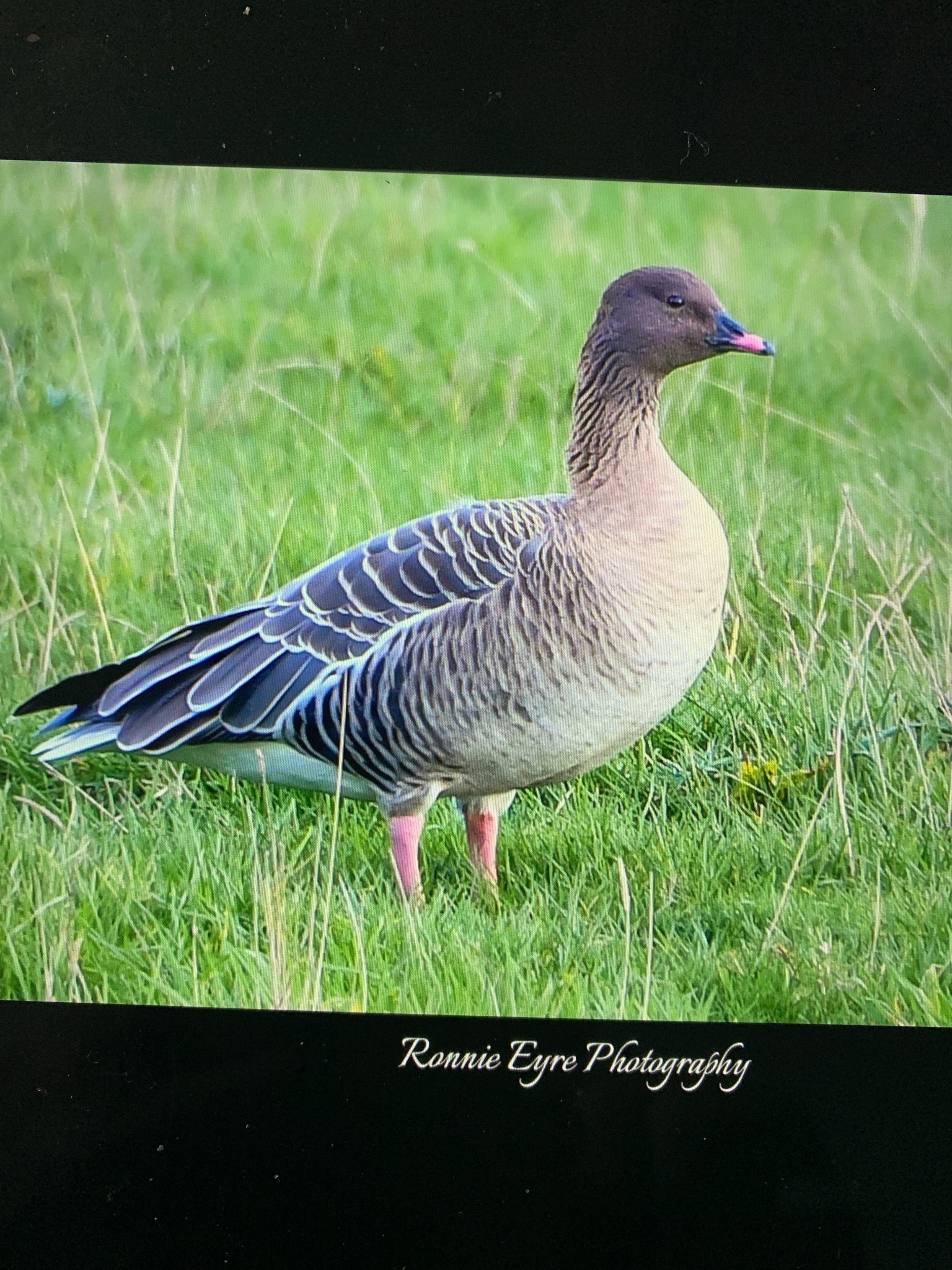
A medium-sized grey goose with a relatively short, stubby bill that is dark at the base and tip with a distinct pink band in the middle. It has pink legs and feet, and distinctive dark and grey-brown patterning on the body.
Explore Pink-footed Goose in the encyclopedia →Identify your own birds.
Get a report just like this from any photo or call, free.
Plumage & appearance
Head and upper neck are dark brown, contrasting with a paler grey-brown breast and body. Mantle and upperwing coverts are grey-brown with pale fringes. Rump is greyish-white, and the tail is dark with a white tip. Juveniles resemble adults but are generally duller with less distinct barring.
Key field marks
Small compact size, short dark-and-pink bill, pink legs, brown head and neck contrasting with pale grey-brown breast, and greyish upperwing coverts.
Size & weight
Length: 60-75 cm; Wingspan: 135-170 cm; Weight: 1.8-3.4 kg.
Voice — call & song
A high-pitched, musical, and talkative two-note 'wink-wink' or 'fee-unk' call, higher-pitched than the call of the Greylag Goose.
Diet & foraging
Herbivorous; feeds on grasses, agricultural crops (such as potatoes, sugar beets, and grain leftovers), roots, and leaves.
Habitat
Breeds in tundra cliffs, plateaus, and near rivers in the high Arctic. Winters in agricultural land, coastal marshes, and estuaries.
Migration & movement
Migratory; undertakes regular long-distance migrations between high Arctic breeding grounds and temperate European wintering areas.
Nesting & breeding
Nests on cliff ledges, steep slopes, or islands in the Arctic to avoid predators. Lays 3 to 6 cream-white eggs in a scrape lined with down and plant material.
Similar species
Bean Goose (Anser fabalis), which is larger with a longer, more extensive orange-yellow and black bill without the pink band.
Ecological significance
Acts as a seed disperser and grazes on vegetation, which can influence plant community composition in both breeding and wintering grounds.
Conservation status
Least Concern (LC), with an increasing population trend.
Observation tips
Look for large flocks feeding in agricultural fields, particularly stubble fields, potatoes, and grassland, often associated with other geese species like Greylag or Barnacle geese.
Interesting facts
Pink-footed geese are known for their strong family bonds and highly synchronized flock movements, often flying in disciplined V-formations during migration.
More like this