Order: Accipitriformes, Family: Accipitridae
Rüppell's Vulture
Gyps rueppellii
A large Old World vulture known for its exceptional flying altitude, broad wings designed for soaring, and a bald head and neck adapted for hygiene while feeding on carcasses.
Explore Rüppell's Vulture in the encyclopedia →Identify your own birds.
Get a report just like this from any photo or call, free.
Plumage & appearance
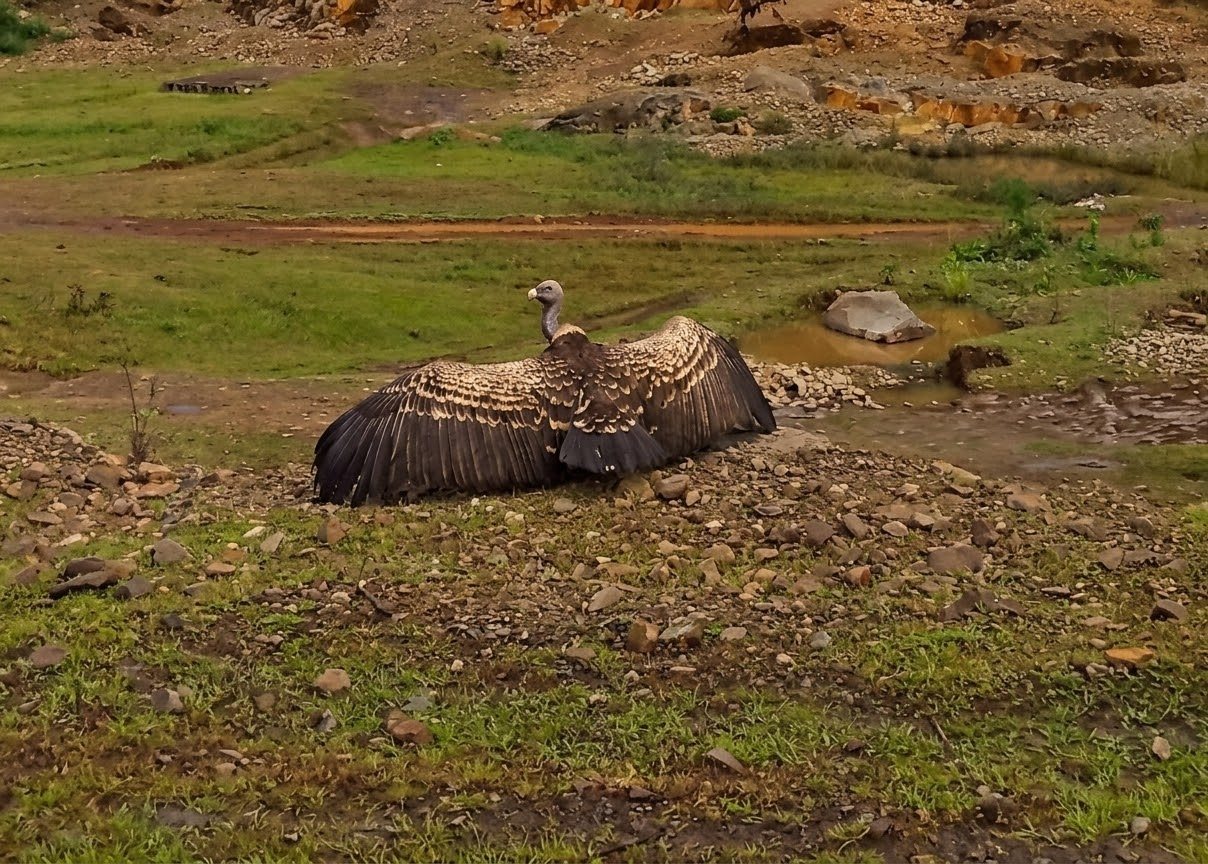
Dark brown or blackish body plumage with pale fringes on the wing coverts giving a scaly appearance. Adults have a white ruff around the base of the neck. Juveniles are darker overall with less distinct patterning and a brownish neck ruff.
Key field marks
Large size, dark scaly-patterned wings and body, white neck ruff, pale bill, and a bare bluish head and neck.
Size & weight
Length: 85–101 cm, Wingspan: 2.2–2.6 meters, Weight: 7–9 kg.
Voice — call & song
Generally silent away from breeding colonies and feeding sites, but emits grunts, hisses, and cackles when squabbling over food.
Diet & foraging
Strictly carnivorous, feeding almost exclusively on the soft tissues of medium to large mammalian carcasses.
Habitat
Open habitats, including semi-desert, savanna, grasslands, and rocky mountainous areas up to high altitudes.
Migration & movement
Resident, though individuals can roam vast distances daily in search of food.
Nesting & breeding
Colonial nesters, building stick platforms on remote cliff ledges. Usually lays a single egg per breeding season, incubated by both parents.
Similar species
White-backed Vulture (Gyps africanus), which is generally smaller, lacks the distinct scaly wing pattern, and has a white lower back visible in flight.
Ecological significance
Acts as an essential scavenger by quickly removing animal carcasses from the environment, thereby preventing the spread of diseases.
Conservation status
Critically Endangered, with populations experiencing rapid declines due to poisoning, habitat loss, and hunting.
Observation tips
Look for them soaring high in thermals or gathered in large numbers around recent mammal carcasses in open savannas and near cliffs.
Interesting facts
Rüppell's Vulture holds the record for the highest-flying bird, with a confirmed collision with a commercial aircraft at an altitude of 11,300 meters (37,000 feet) over West Africa.
More like this