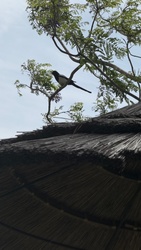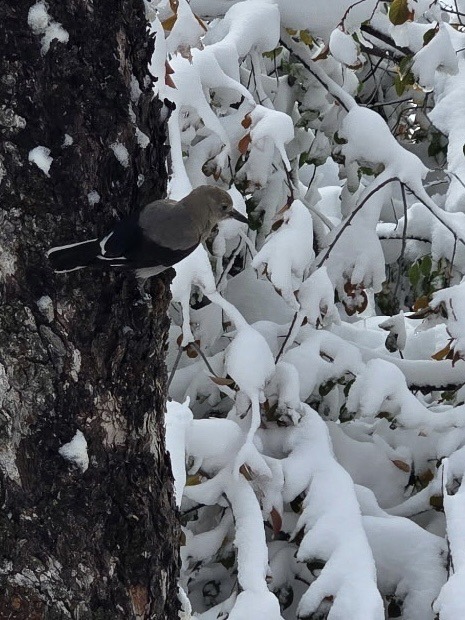
Order Passeriformes, Family Corvidae
Clark's Nutcracker
Nucifraga columbiana
A medium-sized corvid with a stout, pointed black bill, grey body, and striking black-and-white wings and tail. Highly intelligent and energetic, often seen caching seeds or hopping along tree branches.
Explore Clark's Nutcracker in the encyclopedia →Identify your own birds.
Get a report just like this from any photo or call, free.
Plumage & appearance
Light grey head and body with contrasting black and white wings and tail. The central tail feathers and central wing patches are black, while the outer tail feathers and outer wing edges show prominent white. Sexes and ages look similar, though juveniles are slightly duller grey.
Key field marks
Light gray body, stark black wings with a large white patch, black central tail feathers with white outer feathers, and a long, sharp black bill.
Size & weight
Length: 27-30 cm, Wingspan: ~55-60 cm, Weight: 100-160 g
Voice — call & song
A harsh, grating, repeated 'kha-kha-kha' or 'krr-krr' call, quite loud and nasal.
Diet & foraging
Omnivorous, but heavily reliant on pine seeds (especially pinyon pine and whitebark pine). Also eats insects, berries, small rodents, and carrion.
Habitat
High-elevation coniferous forests, subalpine zones, and pine-oak woodlands.
Migration & movement
Resident with nomadic tendencies, frequently engaging in irruptive movements to lower elevations when high-altitude pine seed crops fail.
Nesting & breeding
Breeds very early in the spring (often in late winter while snow is still on the ground). Builds a bulky twig nest high in a conifer. Clutch is usually 2-4 eggs, incubated by both parents.
Similar species
Gray Jay (Perisoreus canadensis), which lacks the striking black-and-white wing pattern and stout black bill of Clark's Nutcracker.
Ecological significance
Crucial keystone species for high-elevation conifer forests, particularly whitebark pine, as they cache millions of seeds annually and facilitate forest regeneration.
Conservation status
Least Concern, though populations fluctuate and face threats from white pine blister rust and climate change.
Observation tips
Look for them in mountainous pine forests, especially near campgrounds or picnic areas where they have learned to look for handouts. Listen for their harsh, grating calls.
Interesting facts
A single Clark's Nutcracker can cache up to 30,000 to 100,000 pine seeds each year across thousands of different hiding spots, remembering the locations with remarkable spatial memory.
User notes
Tree
More like this