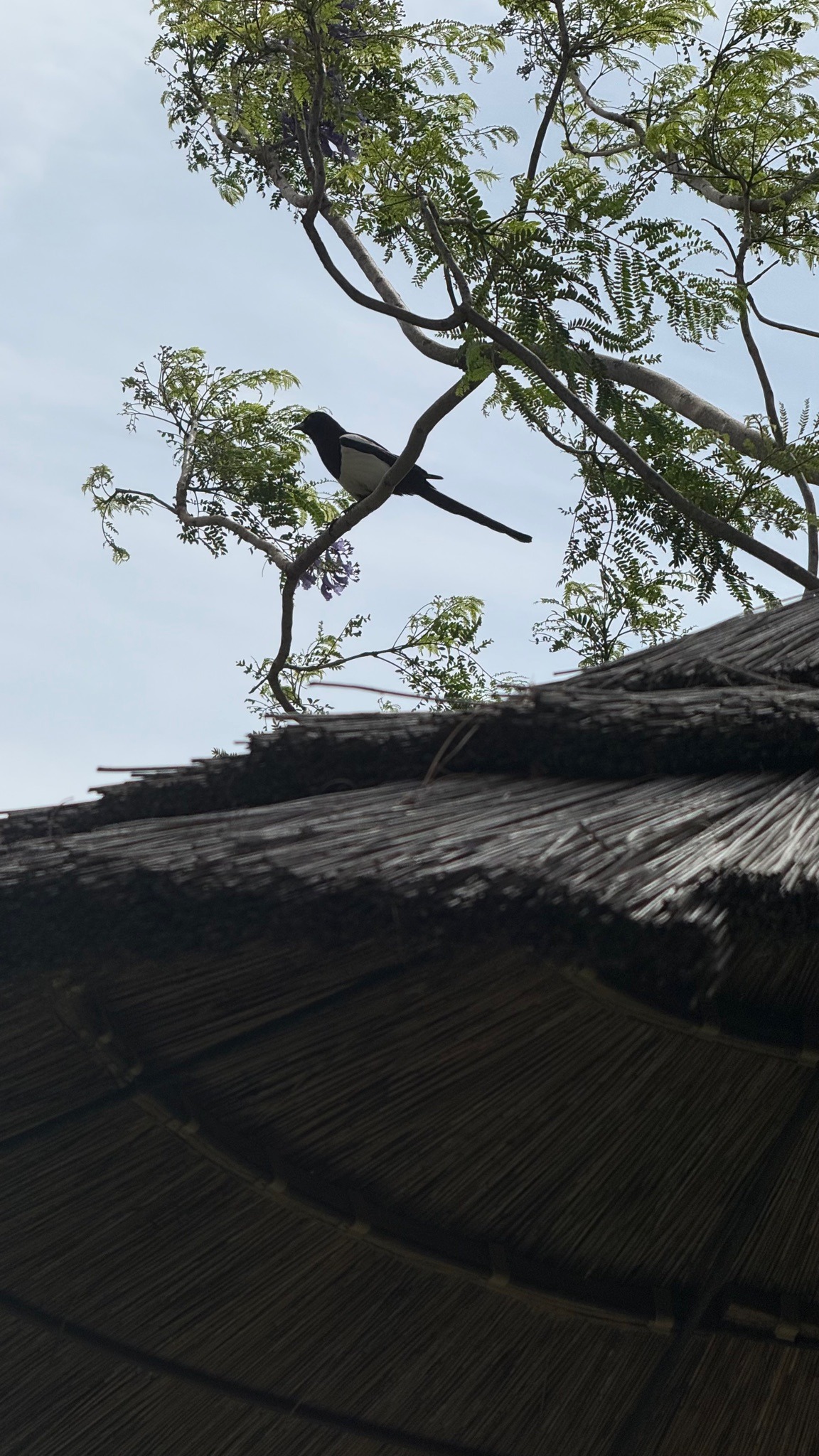
Order: Passeriformes; Family: Corvidae
Eurasian Magpie
Pica pica
A highly intelligent and social bird known for its long, graduated tail and bold black-and-white patterns. They are often seen on the ground or in trees in small groups or pairs.
Explore Eurasian Magpie in the encyclopedia →Identify your own birds.
Get a report just like this from any photo or call, free.
Plumage & appearance
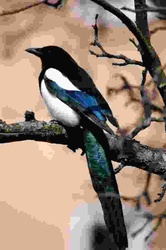
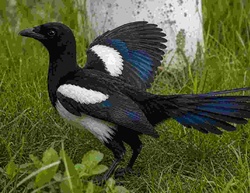
Striking black and white plumage. The head, neck, and breast are glossy black with a metallic green or violet sheen; the belly and scapulars (shoulder feathers) are pure white. The long tail is black with an iridescent green-bronze sheen. Sexes are monomorphic (look identical), though males may be slightly larger.
Key field marks
Long wedge-shaped tail, white belly and shoulder patches, black head and chest, iridescent blue/green in the wings and tail feathers.
Size & weight
Length: 44–50 cm (including tail); Wingspan: 52–62 cm; Weight: 200–250 g.
Voice — call & song
A harsh, rapid chatter described as 'chak-chak-chak-chak'. Also emits various rasps and occasional melodic mimicking notes.
Diet & foraging
Omnivorous and opportunistic. Eats insects, small mammals, eggs, young birds, carrion, seeds, berries, and human food scraps.
Habitat
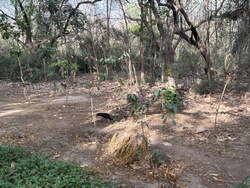
Open woodland, agricultural land, urban parks, and suburban gardens. Avoids treeless plains and dense forests.
Migration & movement
Resident; generally non-migratory, staying in the same territory throughout the year.
Nesting & breeding
Builds a large, domed nest of sticks lined with mud and fine grass, usually high in a tree. Lays 5–8 eggs; the female incubates while the male provides food.
Similar species
Oriental Magpie (very similar, found in East Asia), Azure-winged Magpie (has blue wings and a black cap), Black-billed Magpie (North America; almost indistinguishable except by range).
Ecological significance
Acts as an opportunistic scavenger and predator, helping to control insect populations and dispose of carrion. They also spread seeds and provide nesting sites for other species (like kestrels) which reuse their old, sturdy nests.
Conservation status
Least Concern (IUCN); stable population.
Observation tips
Look for them in open countryside with scattered trees, parks, and gardens. They are quite vocal and bold, often found near human settlements. Look for the white wing patches (flash) when they fly.
Interesting facts
They are considered one of the most intelligent animals in the world; they are the only non-mammal species known to pass the 'mirror test,' suggesting self-awareness. In many cultures, they are the subject of folklore and superstitions.
More like this