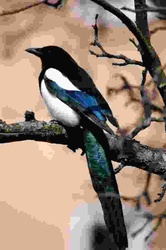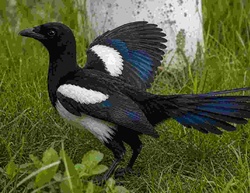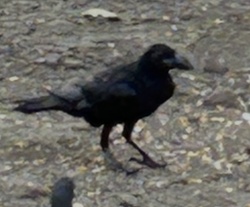
Order: Passeriformes, Family: Corvidae
American Crow
Corvus brachyrhynchos
A large, intelligent, all-black bird with a thick neck and a heavy bill. Crows are highly social, often forming massive winter roosts and exhibiting complex problem-solving skills.
Explore American Crow in the encyclopedia →Identify your own birds.
Get a report just like this from any photo or call, free.
Plumage & appearance
Entirely black with an iridescent violet or blue-green sheen in direct sunlight. Juveniles are similar but have duller brownish-black feathers and blue or gray eyes that turn brown with age.
Key field marks
All-black plumage, stout black bill, fan-shaped tail in flight, and characteristic 'caw' vocalization.
Size & weight
Length: 40-53 cm, Wingspan: 85-100 cm, Weight: 316-620 g
Voice — call & song
A loud, distinct 'caw-caw-caw.' They also produce a variety of rattles, clicks, and barks.
Diet & foraging
Omnivorous and opportunistic. Eats insects, seeds, fruits, small animals, carrion, and human food scraps.
Habitat
Found in a wide variety of habitats including fields, woodlands, suburbs, city parks, and agricultural areas.
Migration & movement
Mostly resident, though northernmost populations may move south in winter to avoid extreme cold.
Nesting & breeding
Builds large stick nests lined with soft materials high in trees. They are cooperative breeders, with young from previous years often staying to help raise the new brood.
Similar species
Common Raven (larger, wedge-shaped tail, croaking voice) and Fish Crow (smaller, nasal 'uh-uh' call).
Ecological significance
Acts as a primary scavenger (sanitation) and seed disperser; also serves as a sentinel, alerting other animals to the presence of predators like hawks and owls.
Conservation status
Least Concern (IUCN); population is stable and adaptable to urban environments.
Observation tips
Crows are easily spotted in open areas and suburbs. Look for them on the ground foraging or in large groups called 'murders.' They are wary and will fly away if approached too quickly.
Interesting facts
Crows have been known to use tools, recognize individual human faces, and even hold 'funerals' for deceased members of their flock.
More like this