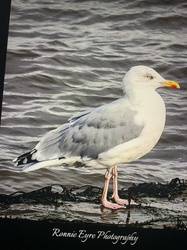
Order: Charadriiformes, Family: Alcidae
Razorbill
Alca torda
A medium-large pelagic seabird with a stout body, distinctive heavy and vertically compressed bill marked with white vertical grooves, and a dark tail that is often held slightly cocked.
Explore Razorbill in the encyclopedia →Identify your own birds.
Get a report just like this from any photo or call, free.
Plumage & appearance
Adults in breeding plumage have a black head, neck, back, and upper wings with a contrasting white underbelly and breast. A thin white line extends from the base of the heavy, blunt bill to the eye. In winter, the throat and cheeks become white, and the bill may appear slightly duller. Juveniles resemble winter adults but have a smaller, less distinctly marked bill.
Key field marks
Deep, vertically flattened black bill with white vertical bars, distinctive white line from bill to eye, solid black upperparts sharply contrasting with white underparts, and a pointed tail.
Size & weight
Length: 38-43 cm (15-17 inches), Wingspan: 60-69 cm (24-27 inches), Weight: 505-905 g (1.1-2.0 lbs).
Voice — call & song
Generally silent at sea, but emits low-pitched growls, grunts, and croaking sounds ('arrr-arrr') at the breeding colonies.
Diet & foraging
Consists mainly of small schooling fish such as sand lances, capelin, sprats, and herring, supplemented by crustaceans and marine worms, caught by pursuit-diving.
Habitat
Marine pelagic environments during the non-breeding season; rocky coastal cliffs, sea stacks, and boulder fields during the breeding season.
Migration & movement
Migratory and dispersive. Northern populations migrate further south into the western and eastern Atlantic, while more southerly populations may be year-round residents.
Nesting & breeding
Does not build a traditional nest. Instead, a single egg is laid directly on bare rock in a sheltered crevice, under boulders, or on a narrow cliff ledge. Both parents incubate the egg and feed the chick.
Similar species
Common Murre (Common Guillemot), which has a pointed bill and lacks the white facial line; Thick-billed Murre, which is bulkier with a shorter bill featuring a white line along the cutting edge.
Ecological significance
Acts as an apex predator in coastal marine food webs, helping regulate fish populations, and serves as an important bioindicator of marine ecosystem health.
Conservation status
Near Threatened globally, though local populations can be affected by oil spills, climate change, and overfishing.
Observation tips
Visit rugged coastal cliffs and rocky islands in the North Atlantic during spring and summer. Use binoculars or a spotting scope to observe them nesting among other alcids like guillemots and puffins.
Interesting facts
Razorbills form long-term monogamous pair bonds and return to the exact same nesting site year after year. They can dive to depths of up to 120 meters (nearly 400 feet) in search of prey.
More like this