Order: Charadriiformes; Family: Alcidae
Atlantic Puffin
Fratercula arctica
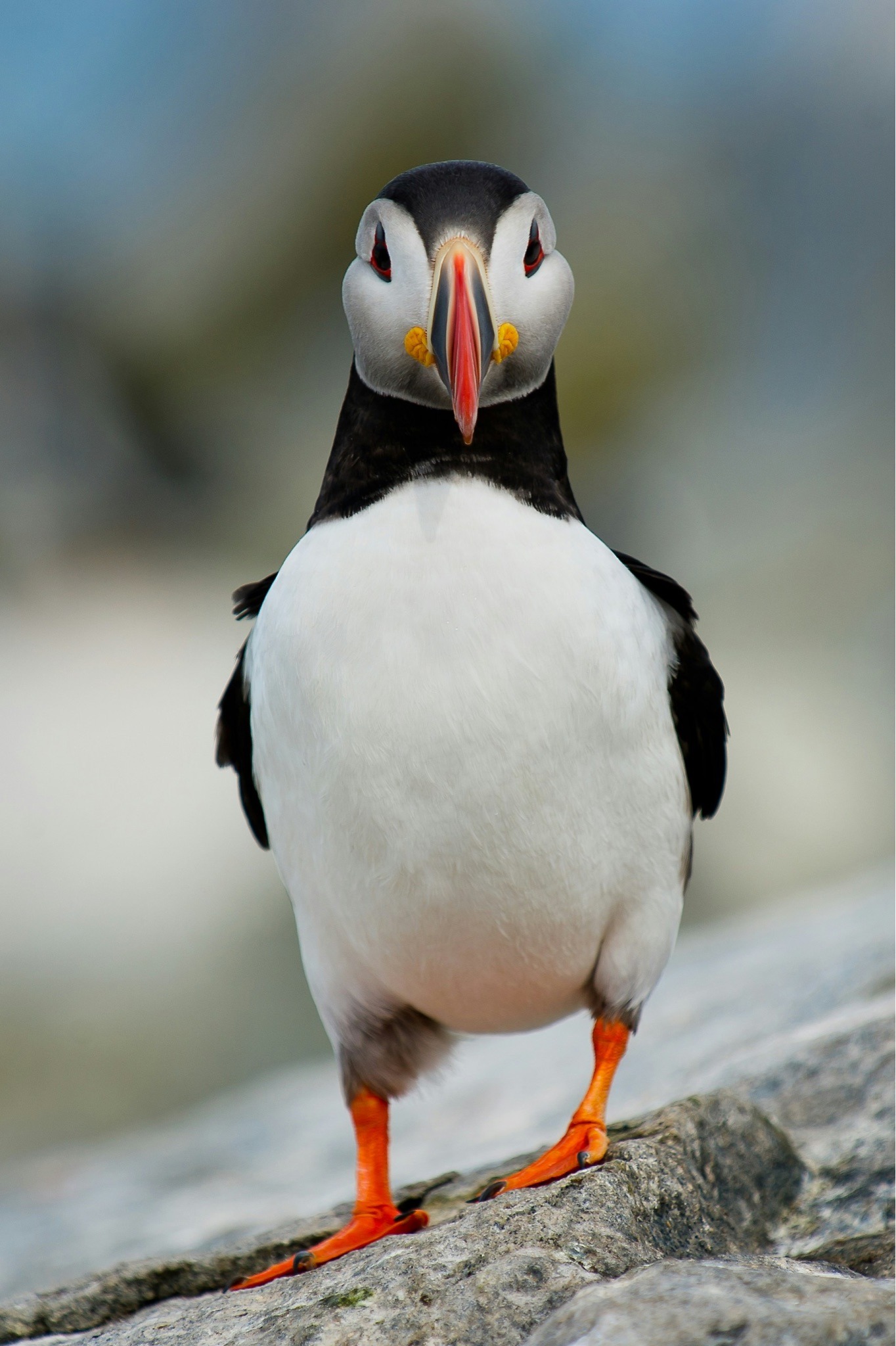
Known as the 'Sea Parrot' or 'Clown of the Sea,' it is a stocky seabird with a large, colorful triangular bill. It is an excellent swimmer and diver, using its wings to 'fly' underwater.
Explore Atlantic Puffin in the encyclopedia →Identify your own birds.
Get a report just like this from any photo or call, free.
Plumage & appearance
Adults in breeding season have black upperparts, white underparts, and pale grey cheeks. Their bills become large, colorful (orange, blue-grey, and yellow). In winter, the bill sheds its outer plates and becomes smaller and duller, and the face turns darker. Sexes look similar.
Key field marks
Large, brightly colored triangular beak; white face patches; upright penguin-like stance on land; orange legs and feet.
Size & weight
Length: 26-29 cm (10-11 in); Wingspan: 47-63 cm (18-25 in); Weight: 320-480 g (11-17 oz).
Voice — call & song
Generally silent at sea. At the colony, they make a low, growling 'arr-arr-arr' or 'koo-uh' sound from inside their burrows.
Diet & foraging
Mainly small forage fish such as sand eels, herring, and capelin. They catch fish by diving and can carry up to a dozen fish at once in their serrated bills.
Habitat
Open ocean for most of the year; rocky cliffs and grassy islands for nesting during the breeding season.
Migration & movement
Migratory/Dispersive; they spend the non-breeding season widely distributed across the open North Atlantic, reaching as far south as Morocco and the Mediterranean.
Nesting & breeding
They nest in burrows dug into the soil or among rocks. They lay a single egg per year. Both parents share incubation and chick-rearing duties. Breeding season is typically April through August.
Similar species
Horned Puffin (Pacific Ocean, has a yellow 'horn' above eye), Tufted Puffin (Pacific Ocean, has long yellow head tufts), and Razorbill (thinner, all-black bill).
Ecological significance
A key indicator species for ocean health and fish populations. They help cycle nutrients between the sea and land through their guano at nesting sites.
Conservation status
Vulnerable (IUCN Red List). Populations are declining due to climate change affecting food supply and pollution.
Observation tips
Best observed at breeding colonies on coastal cliffs or offshore islands. Use a long lens to avoid disturbing nests, and visit during the early morning or evening when birds return with fish.
Interesting facts
Atlantic Puffins can dive to depths of 60 meters (200 feet). Their beaks glow under UV light, though the purpose of this is still being researched by scientists.
More like this