Order: Passeriformes, Family: Paridae
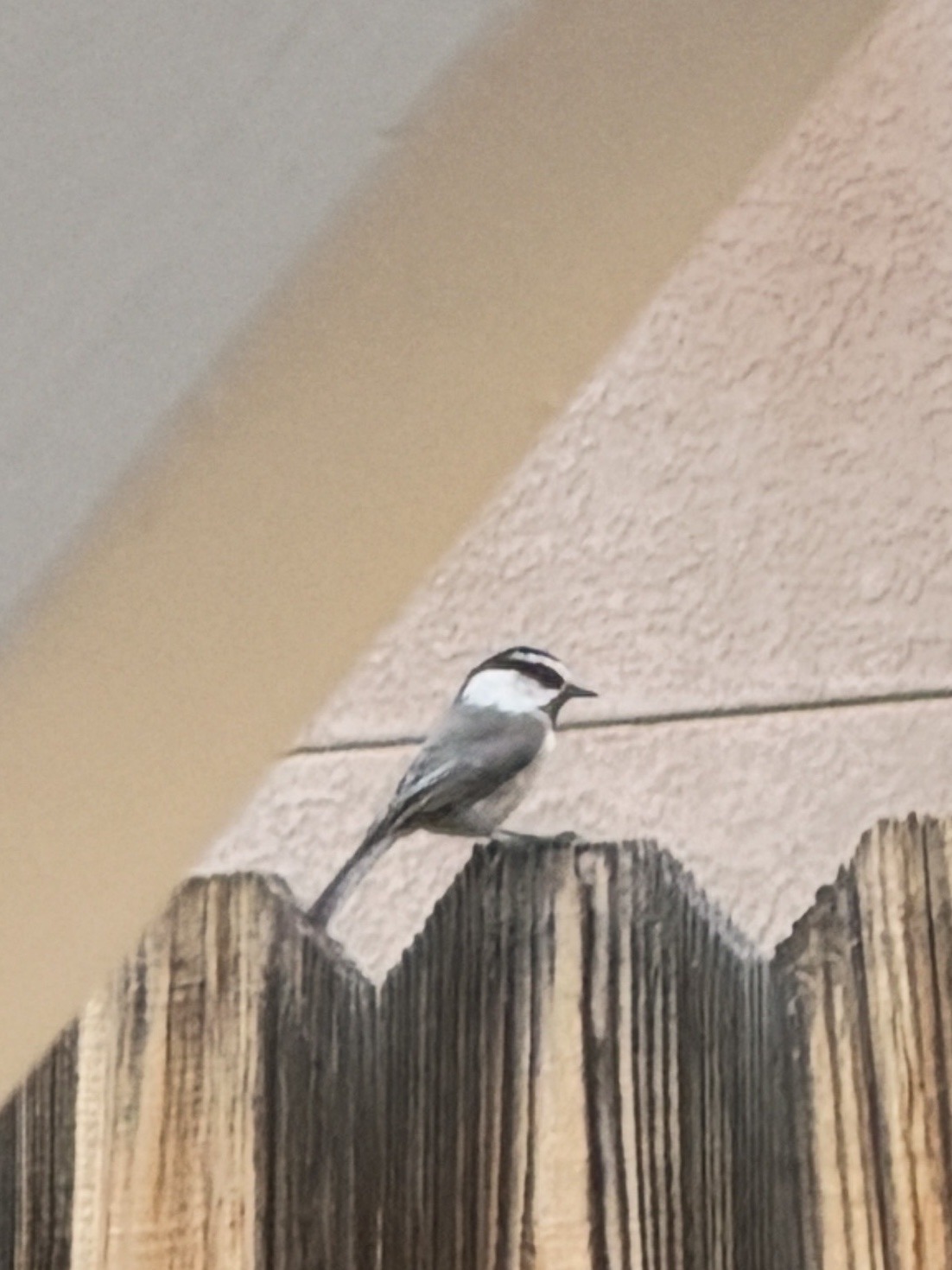
Mountain Chickadee
Poecile gambeli
A small, active, acrobatic bird with a relatively large head, short neck, and stubby bill. Known for hopping energetically among branches and hanging upside down while foraging.
Explore Mountain Chickadee in the encyclopedia →Identify your own birds.
Get a report just like this from any photo or call, free.
Plumage & appearance
Features a distinctive white eyebrow (supercilium) stripe above a black cap and black throat, contrasting sharply with grey back, wings, and tail, and whitish underparts with buffy flanks. Sexes are visually similar, and juveniles have slightly duller plumage.
Key field marks
White eyebrow stripe above the black cap, black bib, grey upperparts, and pale flanks.
Size & weight
Length: 12-14 cm (4.7-5.5 in), Wingspan: 19-22 cm (7.5-8.7 in), Weight: 9-14 g (0.3-0.5 oz)
Voice — call & song
The song is a clear, three-note descending whistle 'fee-bee-fee-bee' or 'chick-a-dee-dee-dee' alarm call, though the chick-a-dee call is slightly higher-pitched and harsher than that of the Black-capped Chickadee.
Diet & foraging
Insects, spiders, seeds, and berries. Forages industriously by gleaning from foliage, bark crevices, and cones, often storing food in caches for later use.
Habitat
Primarily high-elevation coniferous forests, including pine, fir, and spruce woods, as well as mixed woodlands and sometimes pinyon-juniper areas.
Migration & movement
Permanent resident, though some high-elevation populations may make short-range altitudinal movements down to lower valleys during harsh winters.
Nesting & breeding
Nests in natural tree cavities or old woodpecker holes, sometimes excavating their own in rotting wood. Lays a clutch of 5 to 9 white eggs with reddish-brown spots, incubated primarily by the female.
Similar species
Black-capped Chickadee, which lacks the prominent white eyebrow stripe above the black cap.
Ecological significance
Acts as an important predator of forest insects, helping to control pest populations. They also cache seeds, contributing to forest regeneration.
Conservation status
Least Concern, with stable populations.
Observation tips
Easily attracted to backyard bird feeders offering sunflower seeds, suet, or peanuts. Listen for their distinctive hoarse call to locate them in coniferous or mixed forests.
Interesting facts
Mountain Chickadees have remarkable spatial memory, allowing them to relocate thousands of individual food items they hide in scattered cache sites during the autumn.
More like this