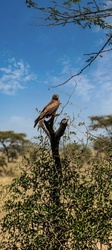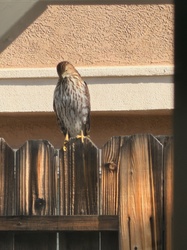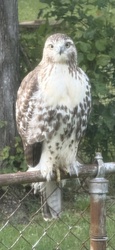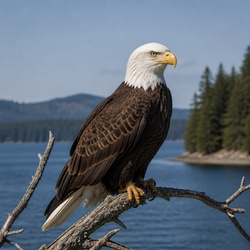
Order: Accipitriformes, Family: Accipitridae
Red-shouldered Hawk
Buteo lineatus
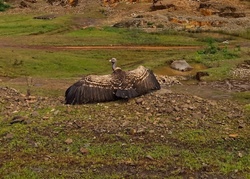
A medium-sized Buteo hawk with a relatively long tail and rounded wings. Known for perching quietly in high trees or near water, and frequently soaring in circles with distinct translucent window patches near the wingtips.
Explore Red-shouldered Hawk in the encyclopedia →Identify your own birds.
Get a report just like this from any photo or call, free.
Plumage & appearance
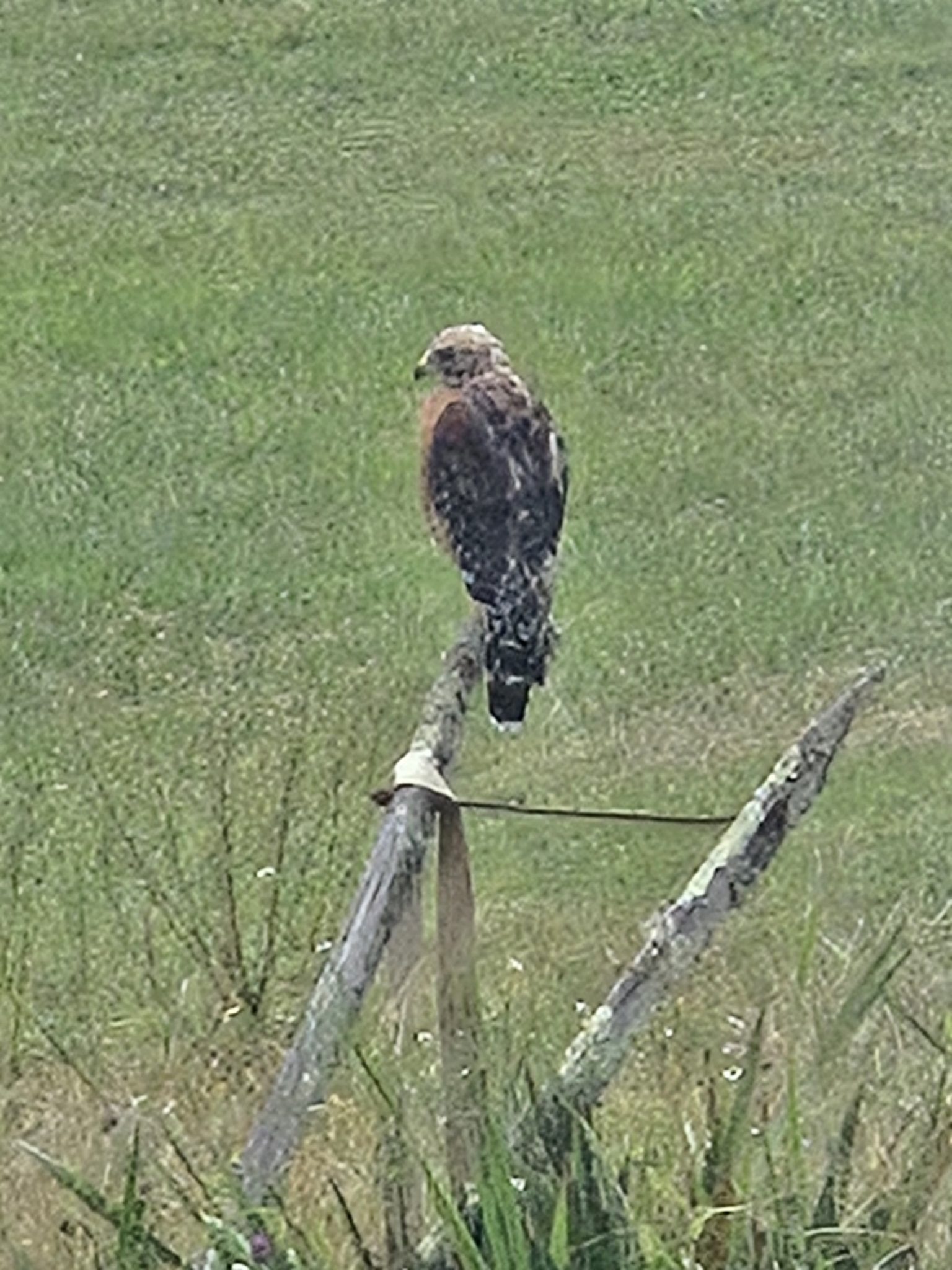
Adults feature a distinctive reddish-brown or rufous shoulder patch (lesser coverts), reddish-barred underparts, and a checkered black-and-white pattern on the upperparts and wings. The tail is dark with narrow white bands. Juveniles lack the rufous shoulders and checkered upperparts, showing brownish streaks on the breast and a duller tail.
Key field marks
Distinctive reddish shoulder patches, barred reddish underparts, checkered black-and-white wings, and a narrowly banded black-and-white tail.
Size & weight
Length: 38–58 cm (15–23 in), Wingspan: 90–105 cm (35–41 in), Weight: 460–930 g (1.0–2.0 lbs).
Voice — call & song
A loud, descending, two-part whistle sounding like 'kee-year, kee-year', often mimicked by Blue Jays.
Diet & foraging
Primarily consumes small mammals (voles, mice), amphibians (frogs, toads), reptiles (snakes, lizards), and large insects. Forages by perching and watching for prey, then dropping down to capture it on the ground.
Habitat
Prefers deciduous and mixed hardwood forests, bottomlands, river swamps, and wooded wetlands. Increasingly adapts to suburban woodlots near water.
Migration & movement
Mostly permanent resident, though northernmost breeding populations are short-distance migrants moving south for the winter.
Nesting & breeding
Constructs a bulky stick nest high up in the crotch of a large deciduous tree, typically near water. Lays 2 to 4 eggs per clutch, incubating them for about 33 days.
Similar species
Broad-winged Hawk (smaller, lacks reddish shoulders and barred underparts) and Red-tailed Hawk (larger, stockier, features a distinct red tail and pale chest band).
Ecological significance
Acts as an apex predator in its woodland ecosystem, helping to control populations of small mammals, amphibians, and reptiles, thus maintaining ecological balance.
Conservation status
Least Concern, with populations currently stable or increasing across much of its range.
Observation tips
Look and listen near deciduous or mixed forests close to rivers, swamps, or standing water. They often perch conspicuously on snags or utility poles near forest edges, making them easier to spot than forest-dwelling hawks.
Interesting facts
Red-shouldered Hawks are remarkably vocal for raptors and can often be heard before they are seen. Their territories are fiercely defended, and breeding pairs often use the same nest year after year, adding new material each season.
More like this