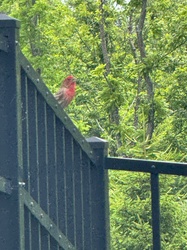
Order: Passeriformes, Family: Fringillidae
American Goldfinch
Spinus tristis
A small, active finch known for its bright yellow and black breeding plumage, bouncing flight pattern, and strong preference for thistle and other seed-bearing plants.
Explore American Goldfinch in the encyclopedia →Identify your own birds.
Get a report just like this from any photo or call, free.
Plumage & appearance
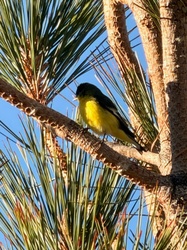
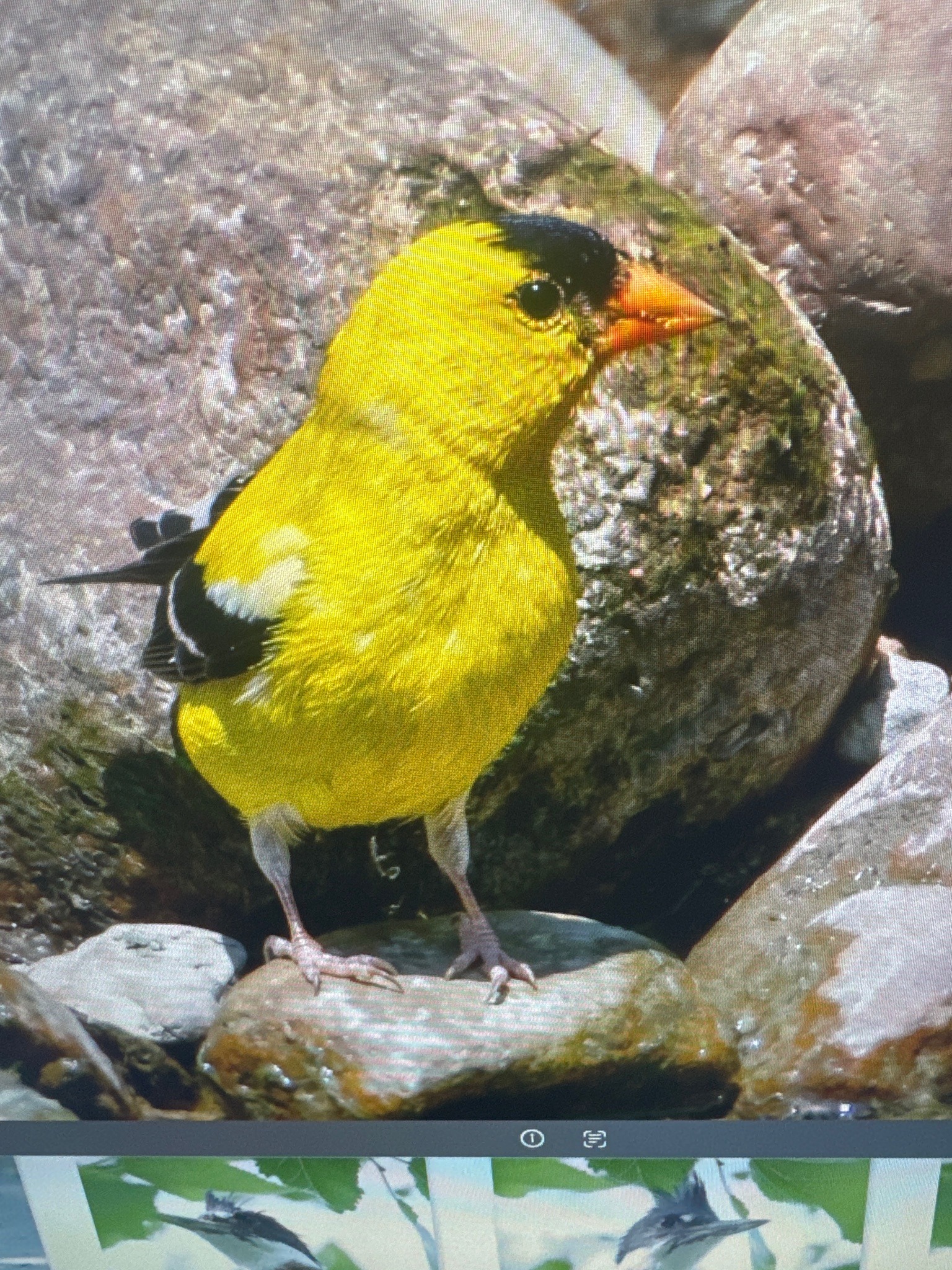
Adult males in breeding plumage have a brilliant yellow body, jet-black forehead patch, black wings with white bars, and a white rump. Females are duller, olive-yellow above and pale yellow below. In winter, both sexes become a drab brownish-olive with dark wings.
Key field marks
Bright yellow body (in summer), black cap, black wings with distinct white wing bars, and a short, conical orange bill.
Size & weight
Length: 11-14 cm (4.3-5.5 in), Wingspan: 19-22 cm (7.5-8.7 in), Weight: 11-20 g (0.4-0.7 oz)
Voice — call & song
A bouncy, musical song consisting of a series of warbling notes and trills. Its most famous call is a distinctive, soaring 'per-chick-o-ree' given in flight.
Diet & foraging
Strictly granivorous, feeding almost exclusively on seeds from weeds like thistles, dandelions, and sunflowers, as well as tree buds and birch catkins.
Habitat
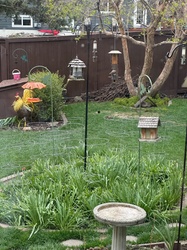
Found in open country, weedy fields, cultivated lands, floodplains, and backyard gardens with brush and trees.
Migration & movement
Short to medium-distance migrant; highly nomadic during winter in search of reliable food sources.
Nesting & breeding
Late breeder (July to September) to coincide with the abundance of plant down used for nest lining and seeds to feed young. Builds a tightly woven, cup-shaped nest in tree forks; clutch size is 2-7 pale bluish-white eggs.
Similar species
Lesser Goldfinch (smaller with dark back in breeding males) and Pine Siskin (streaky brown plumage).
Ecological significance
Acts as an important seed disperser and controller of weed populations, while also serving as a key prey species for small raptors.
Conservation status
Least Concern, with stable populations.
Observation tips
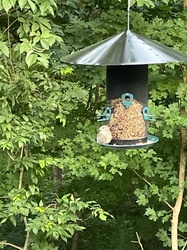
Look for them in weedy fields, gardens, and along woodland edges, especially near bird feeders offering Nyjer (thistle) seed or sunflower seeds.
Interesting facts
American Goldfinches are one of the latest-nesting of all North American songbirds, and they are completely vegetarian for almost their entire lives, feeding even their nestlings seeds instead of insects.
More like this