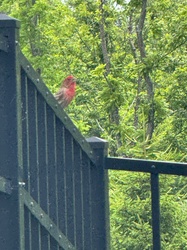
Order: Passeriformes, Family: Fringillidae
American Goldfinch
Spinus tristis
A small, active finch with a conical bill and a distinctive undulating flight pattern. They are highly social and often congregate at feeders.
Explore American Goldfinch in the encyclopedia →Identify your own birds.
Get a report just like this from any photo or call, free.
Plumage & appearance
Adult males in summer are bright yellow with a black forehead and black wings with white bars. Females are duller olive-yellow. In winter, both sexes molt into a drab brownish-olive plumage with blackish wings for identification.
Key field marks
Bright yellow body (male summer), black cap, notched tail, white wing bars, and white rump.
Size & weight
Length: 4.3–5.5 in (11–14 cm), Wingspan: 7.5–8.7 in (19–22 cm), Weight: 0.4–0.7 oz (11–20 g).
Voice — call & song
A lively series of musical warbles and trills. The distinctive flight call sounds like 'per-chic-o-ree' or 'po-ta-to-chip'.
Diet & foraging
Strictly granivorous; eats seeds from composites (sunflowers, thistle, asters), grasses, and trees (alder, birch).
Habitat
Open woodlands, weedy fields, floodplains, orchards, and suburban gardens.
Migration & movement
Mid-distance migrant; some populations are year-round residents while northern-most breeders move south for the winter.
Nesting & breeding
A late nester (July–September) to coincide with the glut of thistle seeds. They build a tight cup nest of plant fibers, often so dense it can hold water.
Similar species
Lesser Goldfinch (smaller, darker back), Evening Grosbeak (larger, thicker bill), Pine Siskin (heavily streaked).
Ecological significance
Acts as a seed disperser and is a primary consumer of various weed seeds, helping to control certain plant populations.
Conservation status
Least Concern (IUCN); population is stable and wide-ranging.
Observation tips
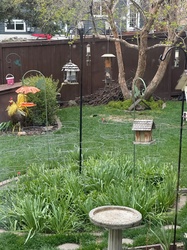
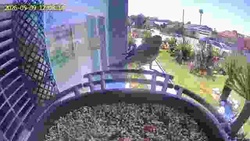
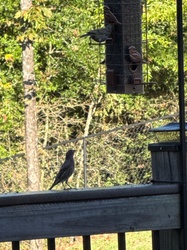
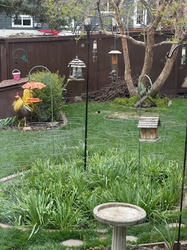
Look for them in open fields with thistles or around backyard bird feeders, especially those offering nyjer (thistle) or sunflower seeds. Their 'po-ta-to-chip' flight call is a great audio clue.
Interesting facts
They are one of the last birds to nest each year. Because they are strict vegetarians, Brown-headed Cowbird chicks rarely survive in Goldfinch nests because they cannot grow on a seed-only diet.
More like this