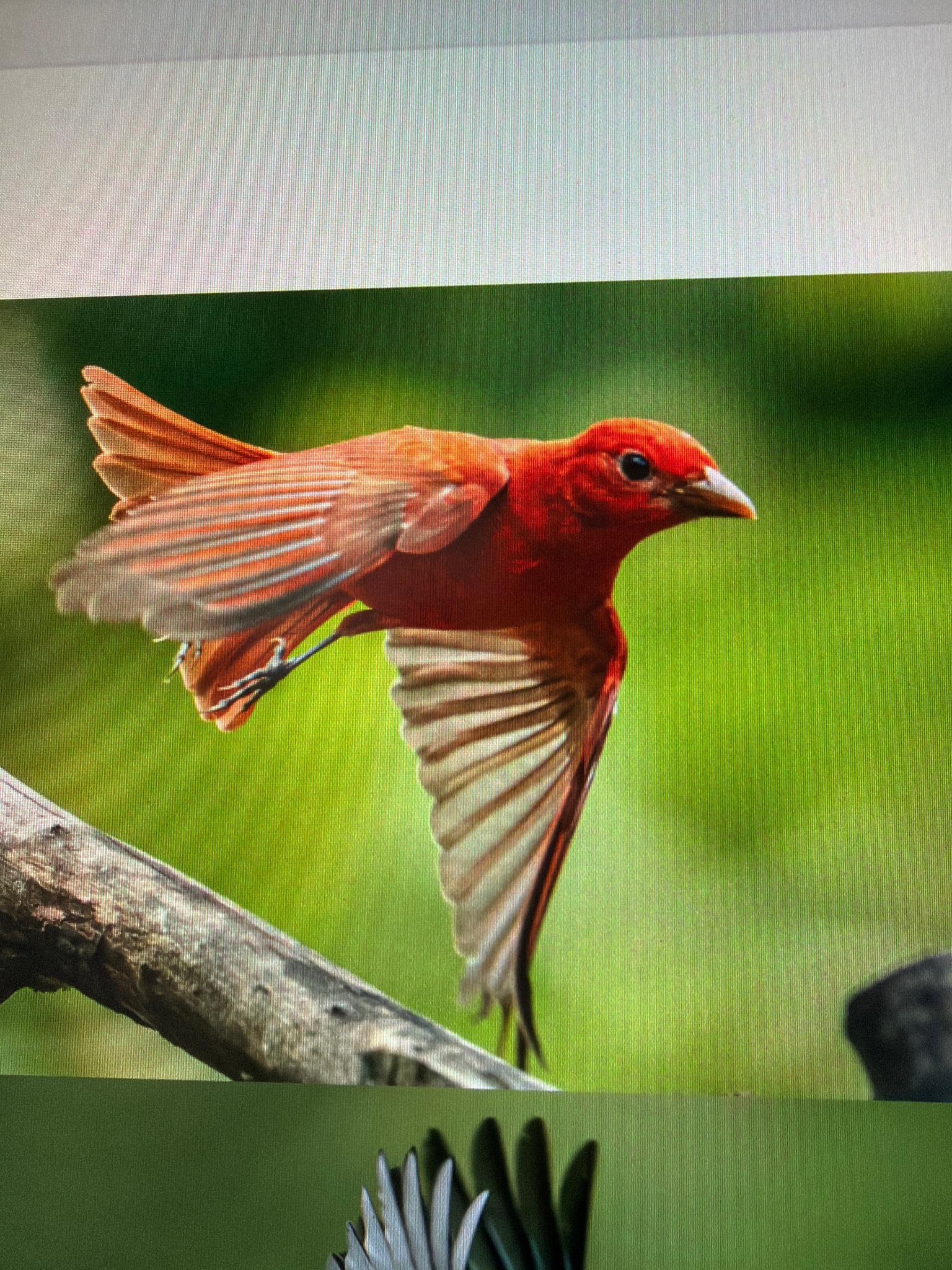
Order: Passeriformes, Family: Cardinalidae
Summer Tanager
Piranga rubra
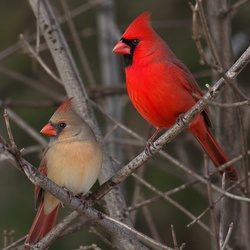
A medium-sized songbird with a stout, pale bill. Males are completely red, while females are yellowish. They are active arboreal birds often seen catching insects in mid-air.
Explore Summer Tanager in the encyclopedia →Identify your own birds.
Get a report just like this from any photo or call, free.
Plumage & appearance
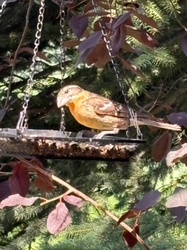
Adult males are entirely rosy-red or strawberry-red. Adult females are a dull mustard-yellow or olive-yellow. Immature males show a patchy transition plumage with red and yellow feathers mixed.
Key field marks
All-red male with no black wings; yellowish female; stout, pale yellowish bill; lack of wing bars on both sexes.
Size & weight
Length: 17 cm (6.7 in), Wingspan: 28 cm (11 in), Weight: 25-35 g (0.9-1.2 oz)
Voice — call & song
Call is a distinct, rhythmic, staccato 'pit-tuck' or 'chup-chup'. Song is a series of rich, musical, robin-like whistles that sound somewhat lazy or hoarse.
Diet & foraging
Insects, especially bees and wasps, as well as berries and fruit. They catch flying insects on the wing or snatch them from vegetation.
Habitat
Open deciduous and mixed forests, particularly oak woods, forest edges, river valleys, and sometimes suburban shade trees with mature vegetation.
Migration & movement
Neotropical migrant; spends winters in Central and South America and returns north to the United States and northern Mexico to breed.
Nesting & breeding
Builds a loose, shallow cup nest of twigs, grass, and bark strips on a horizontal tree branch, usually far out from the trunk. Clutch size is typically 3 to 4 pale blue or greenish eggs spotted with brown.
Similar species
Scarlet Tanager males have black wings and tails (unlike the entirely red Summer Tanager). Female Summer Tanagers resemble other tanagers or female orioles but lack wing bars and have a stouter bill.
Ecological significance
Acts as an important predator of forest insects, particularly wasps and bees, helping regulate populations in woodland ecosystems.
Conservation status
IUCN Least Concern, with stable to slightly increasing populations.
Observation tips
Listen for their distinctive, chip-burbling songs in open deciduous woods, forest edges, or parks. Look high in the canopy where they frequently sally out after flying insects.
Interesting facts
Summer Tanagers are one of the few bird species that routinely specialize in eating stinging insects like wasps and bees. They rub captured wasps against branches to remove the stingers before eating them.
More like this