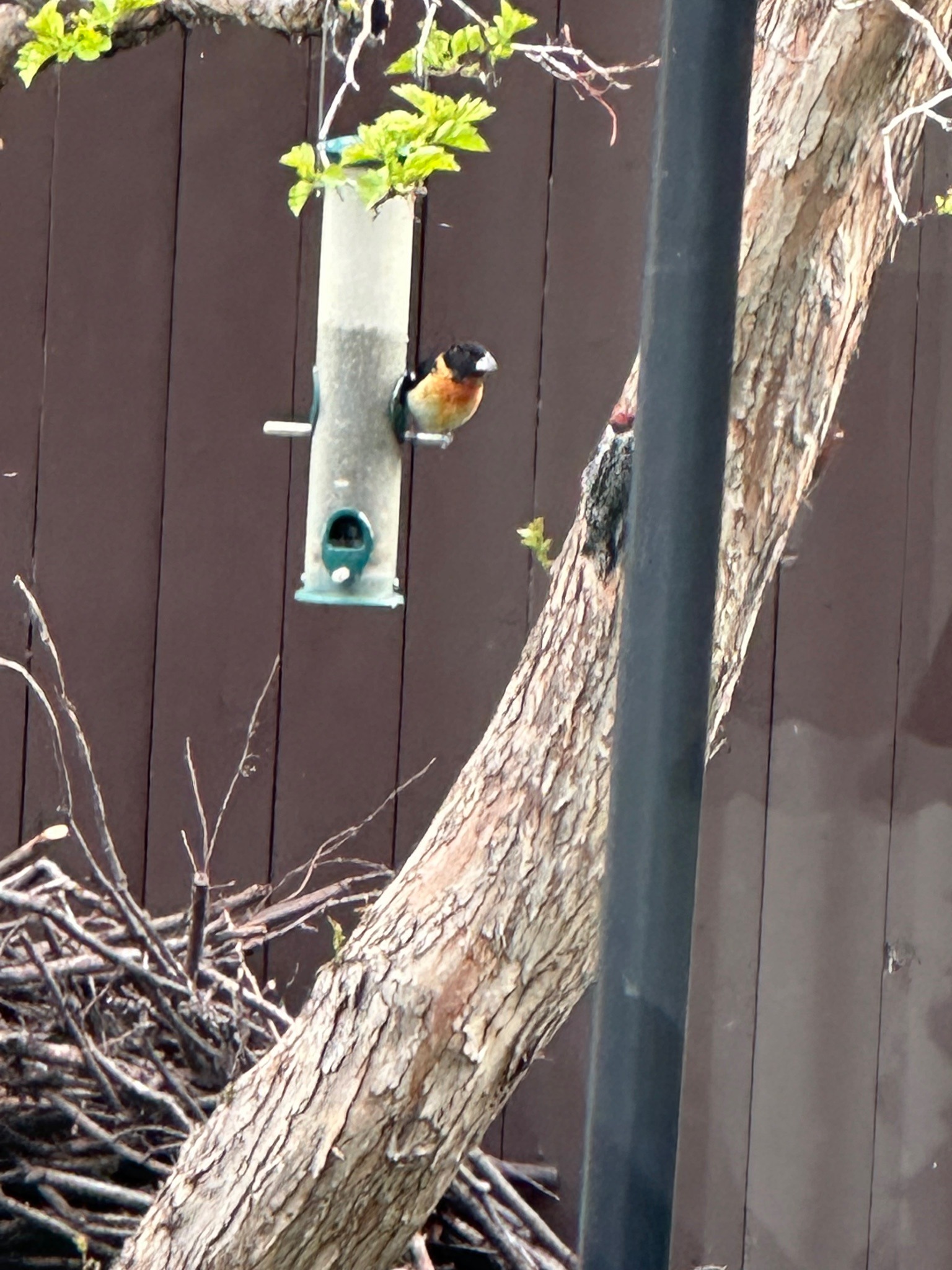
Order: Passeriformes; Family: Cardinalidae
Black-headed Grosbeak
Pheucticus melanocephalus
A hefty songbird with a large, thick cone-shaped bill. They are known for their rich song and ability to crack hard seeds.
Explore Black-headed Grosbeak in the encyclopedia →Identify your own birds.
Get a report just like this from any photo or call, free.
Plumage & appearance
Adult males (pictured) have a black head, cinnamon-orange breast, and black wings white patches. Females and immatures are brown with heavy streaks and a white eyebrow stripe.
Key field marks
Large silver-gray conical bill, black head, bright orange-cinnamon underparts, and black wings with prominent white patches.
Size & weight
Length: 7.1-7.5 in (18-19 cm); Wingspan: 12.6 in (32 cm); Weight: 1.2-1.7 oz (34-49 g).
Voice — call & song
Song is a rich, whistled warble similar to a Robin but more fluid. Call is a sharp, metallic 'pik'.
Diet & foraging
Omnivorous; consumes insects, berries, and large seeds by using its powerful beak to crush them.
Habitat
Deciduous and mixed woods, river thickets, and suburban gardens/parks with tall trees.
Migration & movement
Migratory; travels between breeding grounds in the West and wintering grounds in Mexico.
Nesting & breeding
Builds a cup-shaped nest of twigs in trees or shrubs. Lays 2-5 eggs. Both males and females share incubation and feeding duties.
Similar species
Rose-breasted Grosbeak (males have red chest and white bellies) and Spotted Towhee (smaller bill, red eyes, different orange pattern).
Ecological significance
Acts as a predator of insects and a seed disperser; notably one of the few birds that can eat monarch butterflies despite their toxins.
Conservation status
Least Concern (IUCN); population remains stable.
Observation tips
Commonly visits backyard feeders for sunflower seeds. Look for them in the canopy of deciduous and mixed forests.
Interesting facts
Black-headed Grosbeaks are one of the few birds that have the ability to eat monarch butterflies, as they have developed a tolerance to the cardiac glycosides found in the butterflies.
More like this