Order: Passeriformes, Family: Cardinalidae
Black-headed Grosbeak
Pheucticus melanocephalus
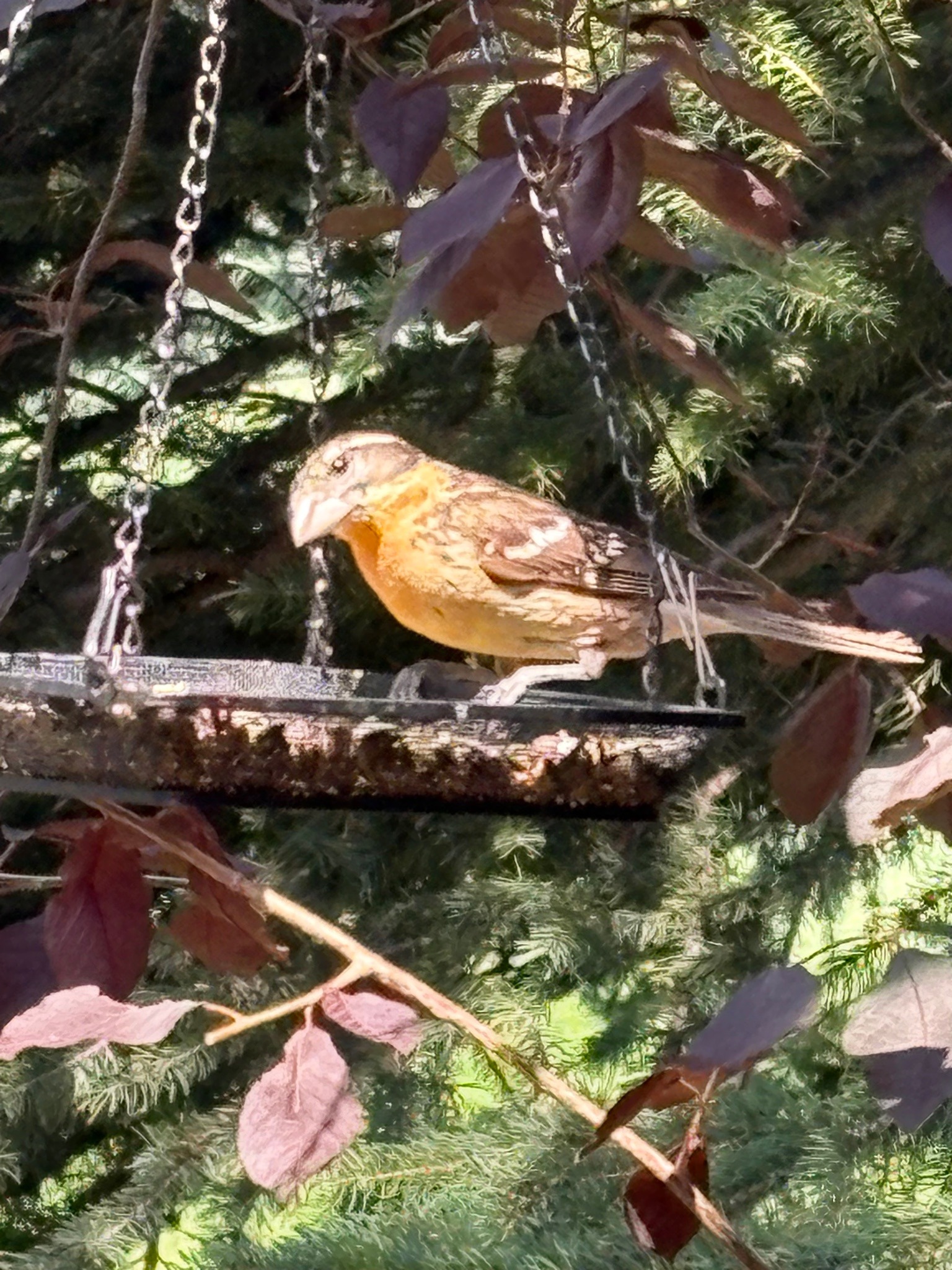
A medium-sized songbird with a massive, pale silvery bill adapted for crushing hard seeds and heavy fruit pits. Females are sparrow-like in overall patterning with warm orange tones underneath.
Explore Black-headed Grosbeak in the encyclopedia →Identify your own birds.
Get a report just like this from any photo or call, free.
Plumage & appearance
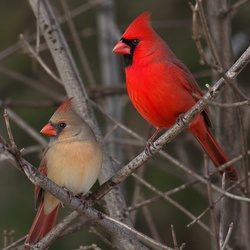
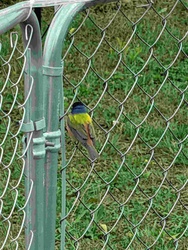
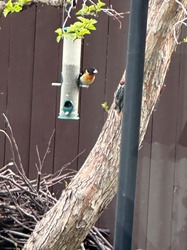
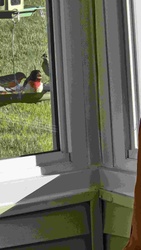
Adult males have a black head, bright orange-buff breast and collar, and black-and-white wings and tail. Females and immatures (shown in the image) have a streaked brown back, buffy-orange breast, distinctive pale eyebrow stripe, and grayish crown with a dark lateral stripe.
Key field marks
Massive pale bill, warm buffy-orange breast, heavily streaked upperparts, and a distinct pale supercilium (eyebrow stripe) in females.
Size & weight
Length: 18-22 cm (7.1-8.7 in), Wingspan: 31-33 cm (12.2-13.0 in), Weight: 35-50 g (1.2-1.8 oz).
Voice — call & song
Song is a rich, rolling, warbling series of notes similar to an American Robin but sweeter and more sustained. Call is a sharp, distinct 'eek' or 'pic'.
Diet & foraging
Primarily seeds, insects, spiders, berries, and fruit. Forages mostly in tree canopies but readily descends to feeders.
Habitat
Open deciduous and mixed forests, particularly near streams, rivers, and forest edges, as well as suburban parks and gardens.
Migration & movement
Migratory; leaves breeding grounds in North America in late summer to spend the winter in Mexico.
Nesting & breeding
Builds a loose, cup-shaped nest out of twigs, weeds, and grass, placed in a fork of a tree or shrub. Clutch size is typically 2 to 5 pale blue-green eggs with brown spots.
Similar species
Rose-breasted Grosbeak females, which look very similar but usually have a whiter underwing lining (yellow in Black-headed) and slightly different facial striping. They hybridize where their ranges overlap in the Great Plains.
Ecological significance
Acts as an important seed disperser and insect predator, helping control populations of forest pests like caterpillars and beetles.
Conservation status
Least Concern, with stable populations.
Observation tips
Often found visiting backyard bird feeders offering sunflower seeds or suet, especially in mountainous or wooded western suburbs.
Interesting facts
Black-headed Grosbeaks are one of the few bird species that actively eat venomous monarch butterflies on their wintering grounds, tolerating the cardiac glycosides stored in the butterfly's body.
More like this