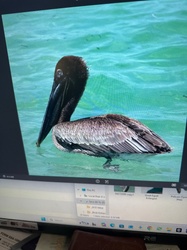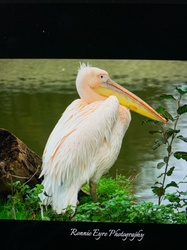
Order: Pelecaniformes, Family: Pelecanidae
American White Pelican
Pelecanus erythrorhynchos
A massive, soaring waterbird with a very long neck, enormous bill with a gular pouch, and broad wings. They fly with slow, powerful wingbeats interspersed with long glides, often soaring high in thermal currents.
Explore American White Pelican in the encyclopedia →Identify your own birds.
Get a report just like this from any photo or call, free.
Plumage & appearance
Bright white body plumage with contrasting black primary and outer secondary flight feathers that are clearly visible from below. Adults have a large orange-yellow bill and throat pouch, and in breeding season, a prominent horn on the upper mandible. Juveniles have grayish plumage tinged with brown, especially on the back of the neck.
Key field marks
Massive size, completely white body contrasted sharply with black wingtips, very long yellowish-orange bill, and a pouch.
Size & weight
Length: 130-180 cm (50-70 in); Wingspan: 240-300 cm (95-120 in); Weight: 5-9 kg (11-20 lbs).
Voice — call & song
Generally silent away from the breeding colony, but adults emit low-pitched grunts, croaks, and groans at the nesting site.
Diet & foraging
Primarily fish, along with occasional amphibians and crustaceans. Unlike brown pelicans, they do not plunge-dive; instead, they scoop up prey while swimming on the water surface, often cooperating in groups to herd fish.
Habitat
Inland freshwater lakes, marshes, and rivers during the breeding season; estuaries, coastal bays, and marine shallows during migration and winter.
Migration & movement
Migratory; travels in flocks southward to coastal regions and Central America for the winter and returns north in the spring.
Nesting & breeding
Nests in large, dense colonies on isolated islands in remote lakes. Constructs a shallow scrape on the ground lined with feathers and debris, laying a clutch of 2 to 3 chalky white eggs incubated by both parents.
Similar species
Snow Goose and Whooping Crane can look white from below, but the black wingtips, massive bill, and soaring silhouette easily distinguish the American White Pelican.
Ecological significance
Acts as an apex predator in aquatic ecosystems, helping to regulate fish populations and serving as an indicator of wetland health.
Conservation status
Least Concern, with stable or increasing population trends.
Observation tips
Look up into the sky near large lakes, rivers, or coastal areas on sunny days to spot kettle-like formations of pelicans soaring high in thermals.
Interesting facts
American White Pelicans can form synchronized swimming lines to herd fish into shallow water for easy catching, and a group of pelicans is collectively known as a 'brief', 'pod', 'pouch', or 'squadron'.
More like this