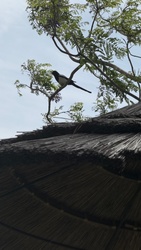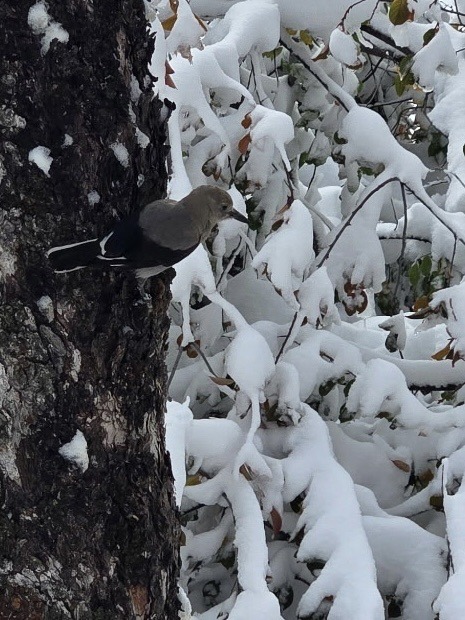
Order: Passeriformes, Family: Corvidae
Clark's Nutcracker
Nucifraga columbiana
A medium-sized corvid with a pale gray body, contrasting black-and-white wings and tail, and a long, pointed black bill suited for prying open pine seeds.
Explore Clark's Nutcracker in the encyclopedia →Identify your own birds.
Get a report just like this from any photo or call, free.
Plumage & appearance
Adults have pale gray heads and underparts with a contrasting white patch on the wings, black central tail feathers with white outer tips, and heavy black wings. Sexes look alike; juveniles are duller and browner with grayish-buff tips on feathers.
Key field marks
Pale gray body, striking black central tail feathers with white outer tail feathers, stark black wings with a prominent white patch on the inner primaries, and a long stout bill.
Size & weight
Length: 27-30 cm (11-12 in); Wingspan: about 50-60 cm (20-24 in); Weight: 125-165 g (4.4-5.8 oz)
Voice — call & song
A loud, harsh, grating, and repetitive series of calls, most commonly described as a harsh 'kha-kha-kha' or 'crak-crak-crak'.
Diet & foraging
Primarily pine seeds, but also insects, berries, small fruits, carrion, and occasionally small vertebrates or eggs. They store food in underground caches for winter.
Habitat
Subalpine and montane coniferous forests, particularly dominated by pinyon pine, ponderosa pine, and whitebark pine trees.
Migration & movement
Permanent resident, but exhibits irruptive behavior, wandering widely to lower elevations or outside the normal range when pine seed crops fail.
Nesting & breeding
Breeds very early in the spring (often in late winter while snow is still on the ground). Builds a bulky twig nest high in a conifer tree. Usually lays 2 to 4 eggs, incubated by both parents.
Similar species
Gray Jay (Canada Jay) lacks the stark black-and-white wing pattern and has a shorter, blunter bill. Pinyon Jay is entirely blue.
Ecological significance
Crucial keystone species for high-elevation ecosystems as they cache millions of pine seeds annually, being the primary seed dispersal mechanism for whitebark pine and other conifers.
Conservation status
IUCN Least Concern, though populations face regional threats from white pine blister rust and climate change affecting pine cone production.
Observation tips
Look in high-elevation pine forests, especially near campgrounds or viewpoints where they may boldly approach humans for food. Listen for their loud, harsh calls.
Interesting facts
Clark's Nutcracker has a sublingual pouch under its tongue that can hold up to around 90-100 pine seeds at one time, allowing it to transport seeds great distances to caching sites.
More like this