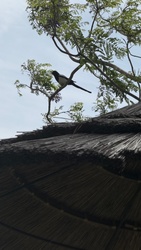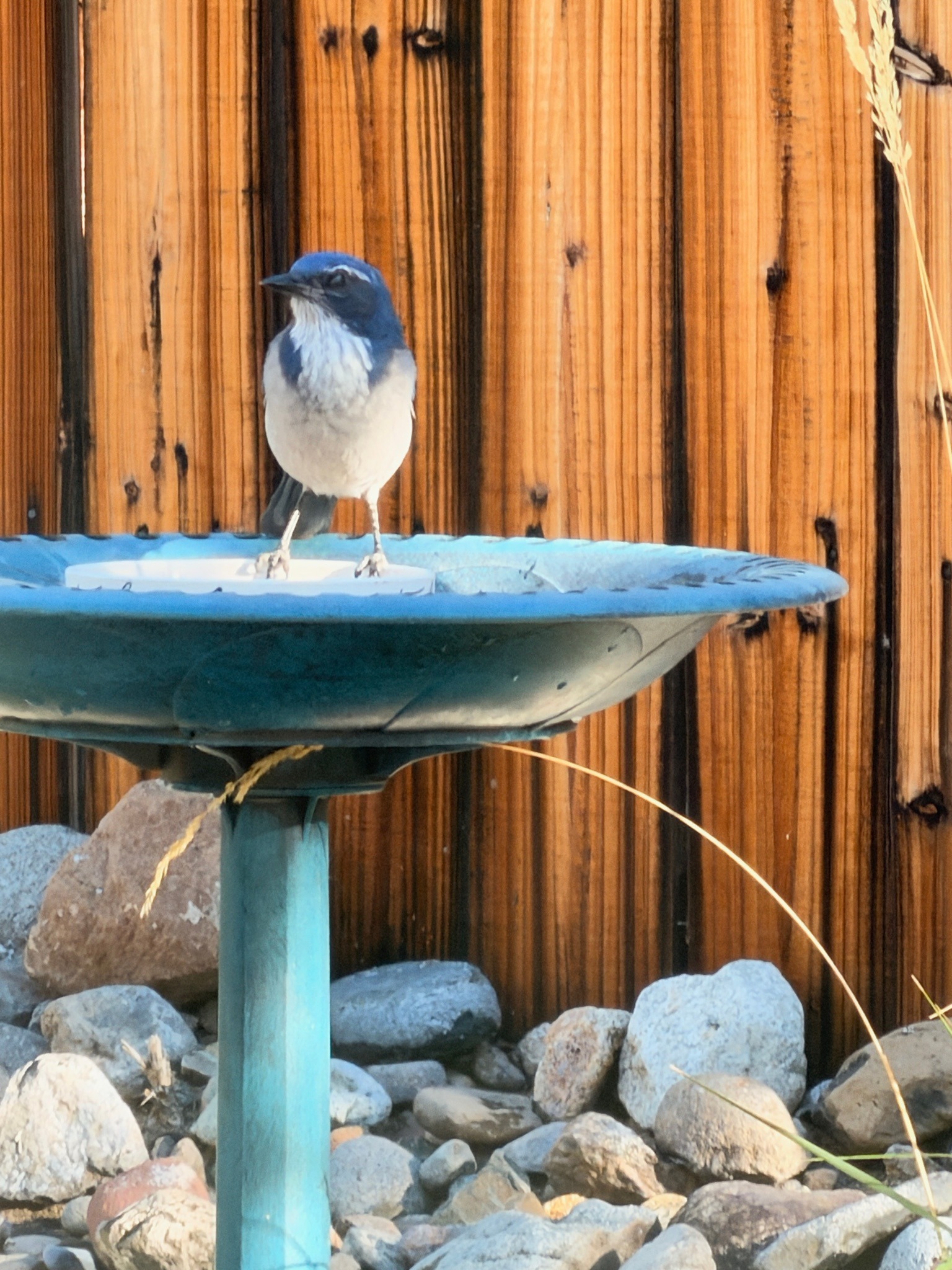
Order: Passeriformes, Family: Corvidae
Woodhouse's Scrub-Jay
Aphelocoma woodhouseii
A medium-sized, long-tailed blue corvid with a distinct white supercilium (eyebrow) and absence of a crest. Highly intelligent, curious, and often bold around human habitations.
Explore Woodhouse's Scrub-Jay in the encyclopedia →Identify your own birds.
Get a report just like this from any photo or call, free.
Plumage & appearance
Azure blue head, wings, and tail; pale grayish-brown back; whitish throat with faint streaking bordered by a partial blue collar or necklace; grayish-white underparts. Sexes look similar, and juveniles are duller with a brownish cast to the head.
Key field marks
Blue head, wings, and tail contrasting with a pale back, whitish throat bordered by a broken blue necklace, lack of a crest, and a stout, slightly hooked black bill.
Size & weight
Length: 27–31 cm (11–12 inches), Wingspan: 36–39 cm (14–15 inches), Weight: 65–100 g
Voice — call & song
A harsh, raspy, repeated 'shick-shick-shick' or a series of rough scolding calls, along with various whistles and chitters.
Diet & foraging
Omnivorous; feeds on acorns, nuts, seeds, berries, insects, spiders, and occasionally small reptiles, eggs, or nestlings of other birds.
Habitat
Arid scrublands, pinyon-juniper woodlands, chaparral, oak foothills, and suburban neighborhoods with mature trees and shrubs.
Migration & movement
Permanent resident; non-migratory, though some high-elevation populations may move to lower elevations in winter.
Nesting & breeding
Builds a bulky cup nest of twigs, roots, and grass lined with finer materials, usually placed in dense shrubs or low trees. Lays 3 to 5 pale greenish or blue-gray eggs spotted with brown. Incubated mainly by the female for about 16-18 days.
Similar species
California Scrub-Jay (darker blue back, grayer underparts, less defined collar), Steller's Jay (has a prominent crest and blackish head), and Pinyon Jay (entirely blue with a shorter tail and conical bill).
Ecological significance
Acts as a key seed disperser, particularly for pinyon pine and oak acorns, significantly influencing forest regeneration and plant distribution.
Conservation status
Least Concern, with stable or generally widespread populations.
Observation tips
Easily spotted in suburban backyards with birdbaths, oak woodlands, and scrub habitats. They are inquisitive and respond well to pishing or food sources, but can be wary if approached too quickly.
Interesting facts
Woodhouse's Scrub-Jay has an exceptional spatial memory, allowing it to cache thousands of acorns each autumn and relocate them months later, even under snow.
More like this