Order: Anseriformes, Family: Anatidae
Mandarin Duck (Female/Eclipse)
Aix galericulata
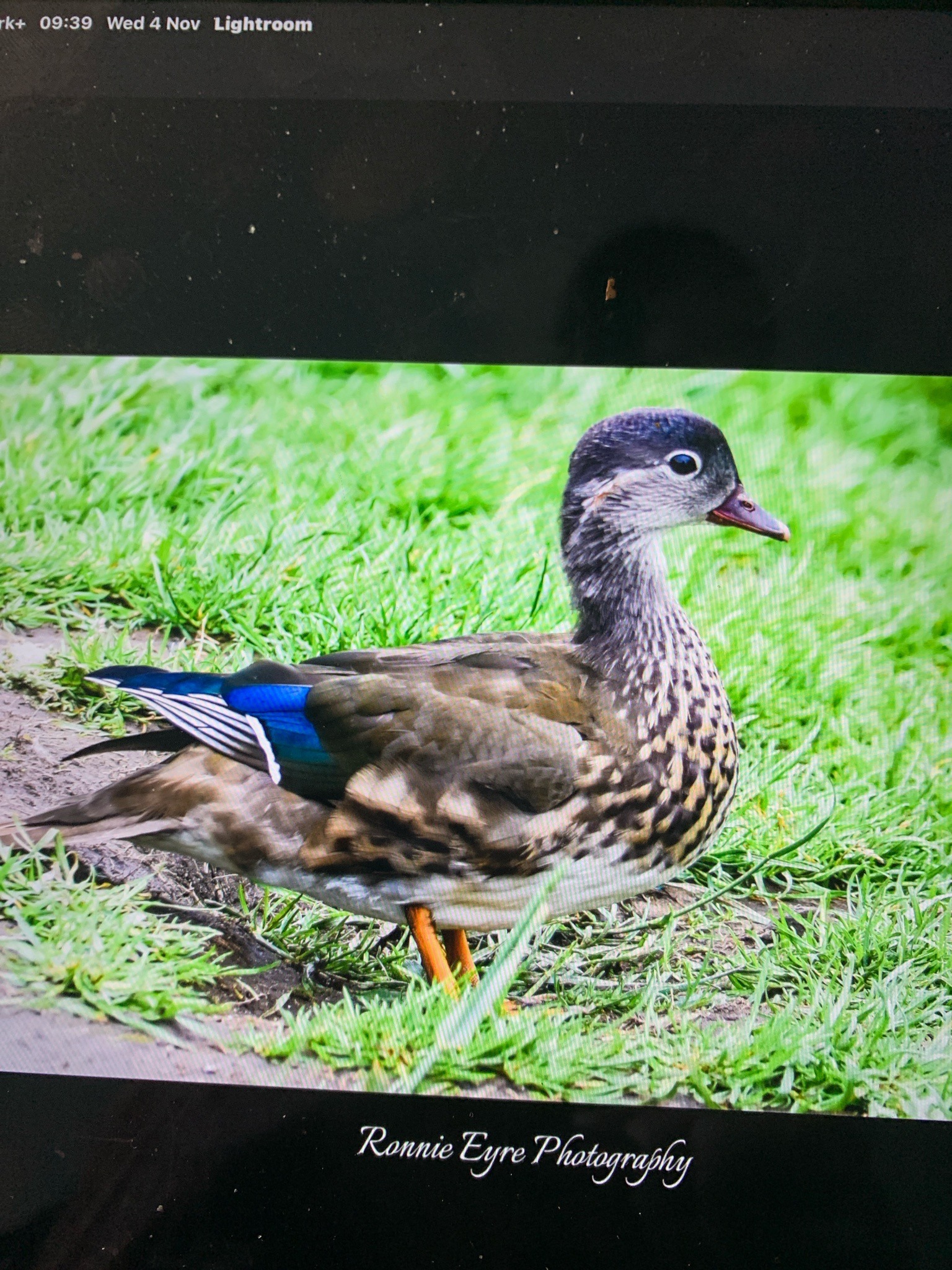
A striking, compact perching duck. While the adult male in breeding plumage is famously ornate with bright colors and 'sails' on its back, the female shown here is more subtly camouflaged with elegant grey and brown tones.
Explore Mandarin Duck (Female/Eclipse) in the encyclopedia →Identify your own birds.
Get a report just like this from any photo or call, free.
Plumage & appearance
Females have a greyish head with a distinct white eye-ring and a thin white stripe extending behind the eye, brownish-olive upperparts, mottled flanks, and a whitish belly with dark spots. Males in eclipse plumage resemble females but retain a brighter red bill.
Key field marks
White eye-ring with a white stripe extending back, greyish head, mottled brown flanks, and yellow-orange legs.
Size & weight
Length: 41-49 cm, Wingspan: 65-75 cm, Weight: 444-600 g
Voice — call & song
Quiet and vocalizes infrequently; females give a soft clucking or repetitive soft calling when disturbed, while males produce a low whistling sound.
Diet & foraging
Omnivorous; feeds on seeds, acorns, grains, aquatic plants, insects, and small mollusks, frequently foraging on land under oak trees.
Habitat
Densely wooded areas near shallow lakes, marshes, rivers, and ponds, with a strong preference for waters surrounded by mature trees for roosting and nesting.
Migration & movement
Mostly resident in its introduced European range; East Asian populations are migratory, wintering in southern China and Japan.
Nesting & breeding
Cavity nesters, typically utilizing natural tree hollows high above the ground. The female lays a clutch of 9-12 eggs, and ducklings leap from the nest shortly after hatching to follow the mother to water.
Similar species
North American Wood Duck (Aix sponsa), which has a similar body shape and perching habit. Female Wood Ducks have a more prominent white teardrop shape around the eye compared to the Mandarin's thin stripe and round eye-ring.
Ecological significance
Acts as a seed disperser and plays a role in aquatic and woodland food webs, often utilizing tree cavities left by other animals.
Conservation status
Least Concern, with stable populations globally and growing feral populations in parts of Europe.
Observation tips
Look for them perched in trees near water or foraging along shaded riverbanks and park ponds. They can be shy, so approaching slowly with binoculars is recommended.
Interesting facts
Mandarin ducks are a symbol of love, fidelity, and marital bliss in Asian cultures because pairs are believed to mate for life. Unlike many other ducks, they frequently perch high up in trees.
More like this