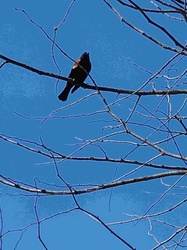
Order Passeriformes, Family Icteridae
Campo Troupial
Icterus jamacaii
A medium-sized, slender oriole with a vibrant orange-and-black color pattern and a sharp, pointed bill adapted for probing fruits and insects.
Explore Campo Troupial in the encyclopedia →Identify your own birds.
Get a report just like this from any photo or call, free.
Plumage & appearance
Striking orange and black plumage with a conspicuous blue patch of bare skin around the eye. The head, throat, wings, and tail are black, while the rest of the body is bright orange. Sexes are similar in appearance, though juveniles are duller with more brownish tones.
Key field marks
Bright orange body contrasting with solid black head, wings, and tail, alongside a bright blue eye-patch.
Size & weight
Length: 23-26 cm; Weight: approximately 55-65 g.
Voice — call & song
Produces loud, clear, flute-like whistles and melodic duets, often very vocal during early morning hours.
Diet & foraging
Omnivorous, feeding on insects, spiders, fruits, nectar, and occasionally seeds.
Habitat
Open and semi-open habitats, including Caatinga scrub, dry forests, savanna-like cerrado, and urbanized gardens.
Migration & movement
Non-migratory resident throughout its range.
Nesting & breeding
Builds a pendant, basket-like nest woven from plant fibers, usually suspended high in a tree or cactus. Clutch size is typically 2-3 eggs.
Similar species
Other troupials like the Venezuelan Troupial (Icterus icterus), but the Campo Troupial is distinguished by its specific geographic range in Brazil and distinct facial skin patterns.
Ecological significance
Acts as an important seed disperser and pollinator through its consumption of fruits and nectar, while also helping control insect populations.
Conservation status
Least Concern, with a stable population trend.
Observation tips
Look for them in open areas, near fruiting trees, or visiting garden bird feeders in northeastern Brazil. They are active and often vocal.
Interesting facts
Known in Brazil as 'Corocha' or 'João-pinto', the Campo Troupial is frequently targeted by parasitic brood birds such as the Shiny Cowbird.
User notes
Pernambuco, Brasil. 17 de setembro.
More like this