Order: Passeriformes; Family: Icteridae
Brown-headed Cowbird
Molothrus ater
A small blackbird with a short, thick, finch-like beak. They are famous for being brood parasites, never building their own nests.
Explore Brown-headed Cowbird in the encyclopedia →Identify your own birds.
Get a report just like this from any photo or call, free.
Plumage & appearance
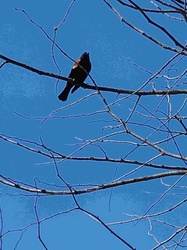
Adult males are glossy black with a distinct chocolate-brown head. Females are plain grayish-brown with faint streaking on the underparts and a pale throat. Juveniles are similar to females but more heavily streaked and scaly-looking.
Key field marks
Smallish size, thick conical beak, and in males, the sharp contrast between a brown head and a glossy black body.
Size & weight
Length: 7.5-8.7 in (19-22 cm); Wingspan: 11.8-15 in (30-38 cm); Weight: 1.3-1.8 oz (38-50 g).
Voice — call & song
Male song is a gurgling 'glug-glug-gleeee'; calls include a high-pitched 'pst-sheee' whistle and a dry rattle.
Diet & foraging
Primarily seeds and grains, but also eats insects (especially grasshoppers and beetles) stirred up by grazing cattle.
Habitat
Open grasslands, brushy areas, pastures, forest edges, and suburban backyards.
Migration & movement
Short-distance migrant; birds in the northern part of the range move south to the US and Mexico for the winter.
Nesting & breeding
Obligate brood parasite. Females lay eggs in the nests of other birds (hosts), who then raise the cowbird chick as their own.
Similar species
Brewer's Blackbird (all black with pale eyes), Brown-headed Blackbird (similar name but different taxonomy), or female Red-winged Blackbird (more heavily streaked).
Ecological significance
As brood parasites, they impact the reproductive success of over 200 other bird species, which has led to population declines in some sensitive host species.
Conservation status
Least Concern (IUCN); population is large and widespread, though it fluctuates based on forest fragmentation.
Observation tips
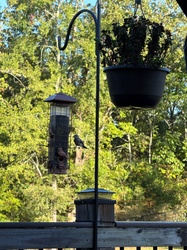
Look for them in open areas, fields, and near bird feeders. They often associate with livestock or larger blackbird flocks.
Interesting facts
A single female can lay up to 40 eggs in a season, distributed among various host nests. They were historically called 'Buffalo Birds' because they followed bison herds across the Great Plains.
More like this