Order: Passeriformes; Family: Passeridae
House Sparrow
Passer domesticus
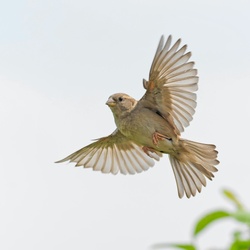
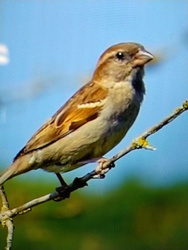
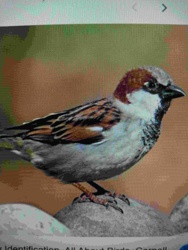
A small, chunky songbird with a stout bill, often seen in large, noisy flocks around human settlements. They are highly social and aggressive toward other birds.
Explore House Sparrow in the encyclopedia →Identify your own birds.
Get a report just like this from any photo or call, free.
Plumage & appearance
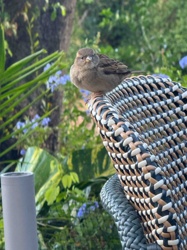
Males have a bold black bib, white cheeks, and a chestnut-brown neck. Females and juveniles are a duller sandy-brown with a pale buffy eyebrow stripe and no black bib.
Key field marks
Stout conical bill, black bib in males, plain unstreaked breast, and a broad pale supercilium in females.
Size & weight
Length: 14-18 cm (5.5-7 in); Wingspan: 19-25 cm (7.5-10 in); Weight: 24-39.5 g (0.85-1.4 oz)
Voice — call & song
A simple, repetitive series of 'cheep' and 'chirrup' notes. They do not have a complex musical song.
Diet & foraging
Primarily seeds and grains, but also eats insects during the breeding season. Frequently scavenges human food scraps.
Habitat
Strictly associated with human-altered environments including cities, suburbs, farms, and industrial sites.
Migration & movement
Resident; they typically do not migrate and remain in their territories throughout the year.
Nesting & breeding
Builds messy, globular nests of grass and feathers in cavities, under eaves, or in nest boxes. Lays 3-7 eggs per clutch; multiple broods per year.
Similar species
Eurasian Tree Sparrow (has a chocolate cap and black cheek spot) and various New World sparrows (usually thinner bills and distinct facial patterns).
Ecological significance
As an invasive species in many regions, they compete with native cavity-nesting birds for resources, but they also serve as prey for urban predators like hawks and owls.
Conservation status
Least Concern (IUCN), though some populations in their native European range are experiencing significant declines.
Observation tips
Easily observed at backyard bird feeders or in city parks. Look for them in areas with outdoor seating or near grain storage.
Interesting facts
House Sparrows are one of the most widely distributed wild birds in the world due to their ability to adapt to human environments.
More like this