Order: Psittaciformes, Family: Psittacidae
Sun Parakeet
Aratinga solstitialis
A medium-sized, vibrantly colored parrot known for its loud calls, playful and social behavior, and striking yellow and orange plumage.
Explore Sun Parakeet in the encyclopedia →Identify your own birds.
Get a report just like this from any photo or call, free.
Plumage & appearance
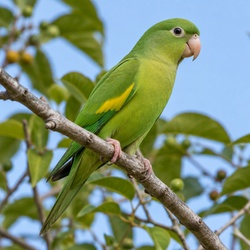
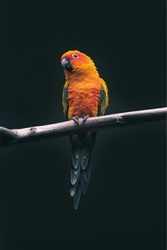
Adults have bright golden-yellow plumage with orange-red on the face, belly, and base of the tail. The wings are predominantly green and blue, and the tail is olive-green tipped with blue. Juveniles are mostly greenish-yellow with duller orange markings.
Key field marks
Extensive bright yellow body, contrasting orange-red face and underparts, blue primary wing feathers, and green-and-blue tail.
Size & weight
Length: 30 cm (12 inches), Wingspan: approx. 40-45 cm, Weight: 100-120 grams.
Voice — call & song
Extremely loud, shrill, and repetitive screeches and squawks, often given in flight or when disturbed.
Diet & foraging
Fruits, flowers, berries, seeds, nuts, and occasionally insects. They forage actively in the forest canopy using their strong beaks and feet.
Habitat
Arid or semi-arid coastal forests, palm groves, dry savannas, and lightly wooded interior lowlands.
Migration & movement
Non-migratory resident, though they may undertake local nomadic movements in search of seasonal food sources.
Nesting & breeding
Nests in tree cavities, typically high up in dead palm trunks. Clutch size is usually 3 to 4 eggs, incubated mainly by the female while the male provides food.
Similar species
Jenday Conure (Aratinga jendaya) and Golden-capped Parakeet (Aratinga auricapillus), both of which have distinct dark green wings and different head/body coloration patterns.
Ecological significance
Acts as a seed disperser for various forest and savanna plants, helping to maintain forest regeneration and biodiversity.
Conservation status
Endangered, with decreasing population trends primarily due to trapping for the pet trade and habitat loss.
Observation tips
Look and listen for flocks high in tree canopies or flying overhead; their loud, screeching calls usually give away their presence before they are seen.
Interesting facts
Sun parakeets form strong, lifelong monogamous pair bonds and are known to preen each other frequently as a sign of affection.
More like this