Order: Psittaciformes; Family: Psittacidae
Blue-and-yellow Macaw
Ara ararauna
A large, intelligent parrot known for its striking colors and long tail. Often seen in pairs or small flocks, they are highly social and vocal birds.
Explore Blue-and-yellow Macaw in the encyclopedia →Identify your own birds.
Get a report just like this from any photo or call, free.
Plumage & appearance
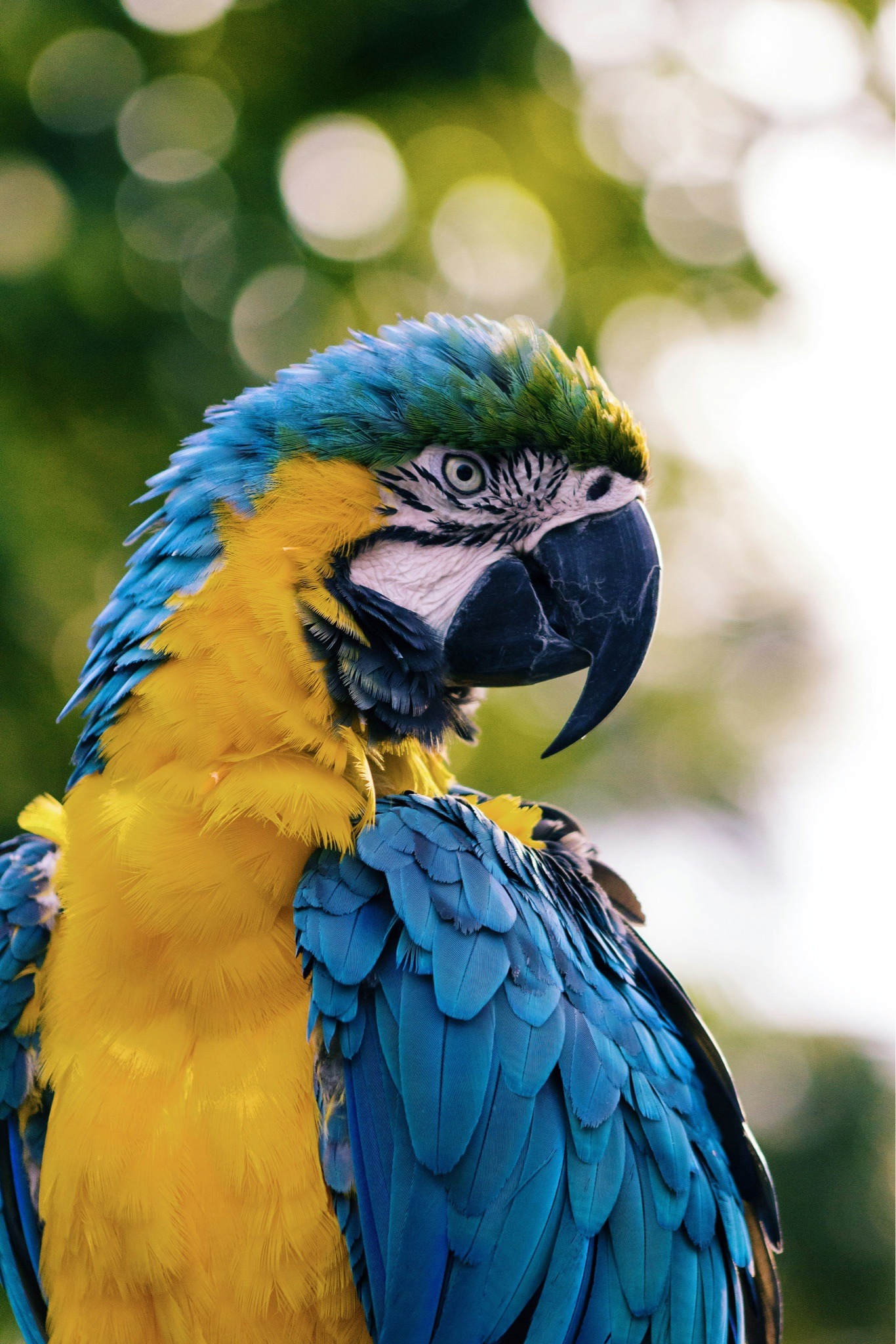
Vibrant blue upperparts (wings and tail) and golden-yellow underparts. It has a green forehead and a white face with fine black feather lines forming a pattern around the eyes. The throat is black. Sexes are monomorphic (look identical).
Key field marks
Large size, blue back, yellow belly, green cap, white face with black lines, and a massive black hooked beak.
Size & weight
Length: 76–86 cm (30–34 in); Wingspan: 102–114 cm (40–45 in); Weight: 900–1500 g.
Voice — call & song
A very loud, harsh, and gutteral 'rrak-rrak-rrak'. They are extremely noisy during flight.
Diet & foraging
Fruits, nuts, and seeds. They use their strong beaks to crack open hard shells. They also visit clay licks to neutralize toxins in their diet.
Habitat
Humid lowland forests, swamp forests, and palm savannas.
Migration & movement
Non-migratory resident, though they may move locally to follow seasonal food or water availability.
Nesting & breeding
Nests in cavities, usually in dead palm trees. They typically lay 2-3 eggs, with the female incubating while the male brings food.
Similar species
Blue-throated Macaw (Ara glaucogularis), which has a teal throat patch rather than black and is much rarer and localized.
Ecological significance
Acts as a primary seed disperser for various rainforest trees and palms, helping to maintain forest diversity.
Conservation status
Least Concern (IUCN), but populations are declining due to habitat loss and the illegal pet trade.
Observation tips
Look for them near riverbanks or palm groves. They are easiest to find by listening for their loud, raucous calls while they fly in pairs across the canopy.
Interesting facts
They are known for their extreme longevity, often living 50-60 years or more. They are also highly intelligent and are capable of mimicking human speech in captivity.
More like this