Order: Bucerotiformes, Family: Bucerotidae
Southern Yellow-billed Hornbill
Tockus leucomelas
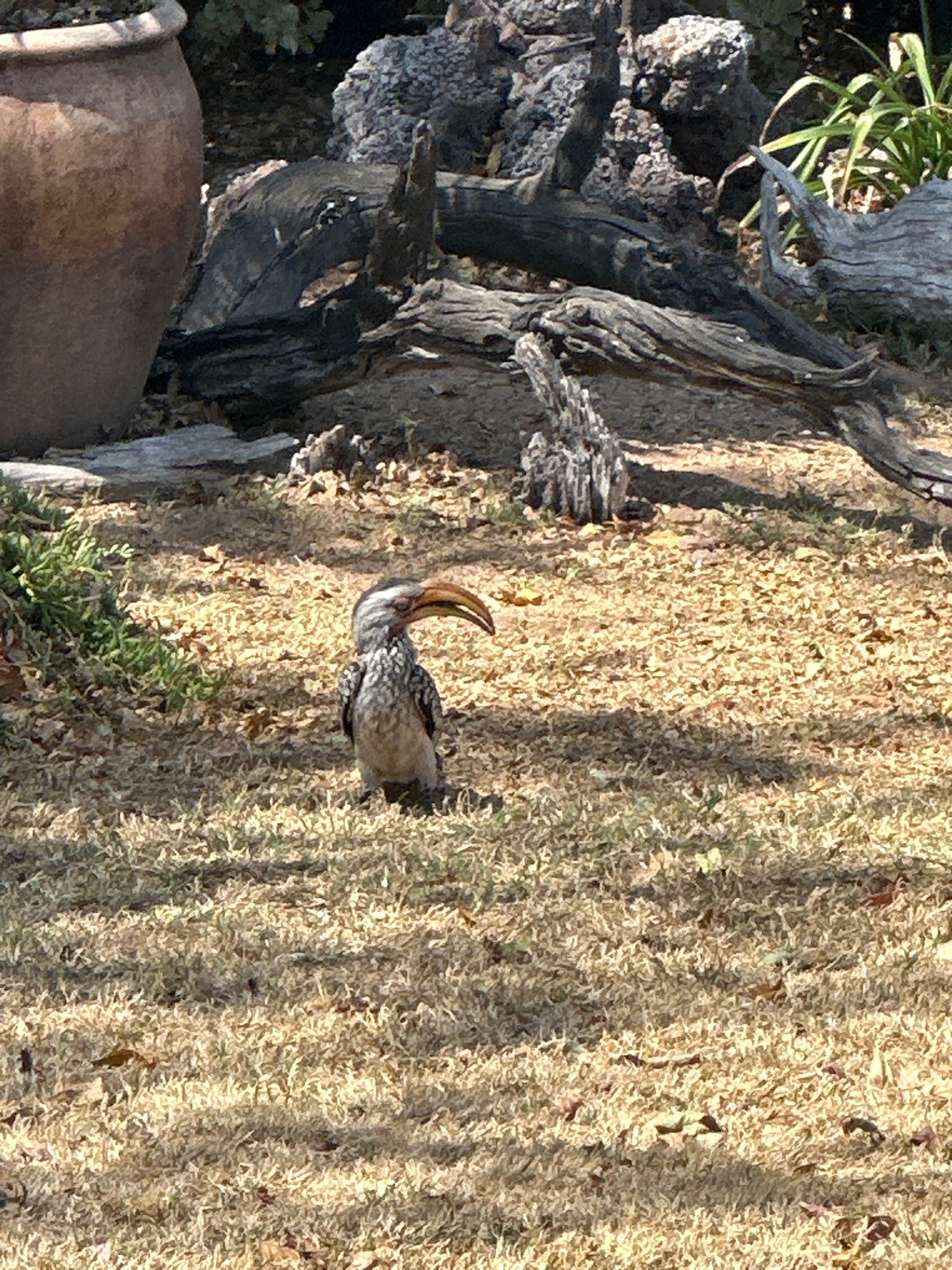
A medium-sized hornbill characterized by its massive, decurved yellow bill with a small casque, whitish underparts, and speckled black-and-white upperparts. Often seen foraging on the ground with an energetic, hopping gait.
Explore Southern Yellow-billed Hornbill in the encyclopedia →Identify your own birds.
Get a report just like this from any photo or call, free.
Plumage & appearance
Gray head and neck with white streaking, white underparts, and black upperparts heavily spotted and barred with white. Wings are black with white spots. The long tail is black with white tips on the outer feathers. Females have a slightly smaller bill and a black patch on the lower mandible, whereas males have an entirely yellow bill with a reddish-brown base.
Key field marks
Large curved yellow bill, speckled grayish head and neck, white underparts, and black-and-white spotted wings and back.
Size & weight
Length: 48-60 cm, Wingspan: approx. 70-80 cm, Weight: 130-240 g
Voice — call & song
A series of loud, clucking or piping notes that accelerate into a cackling sound, often accompanied by wing-raising displays.
Diet & foraging
Omnivorous, feeding on seeds, fruit, small insects, spiders, scorpions, and occasionally small reptiles or nestlings.
Habitat
Arid and semi-arid savannas, thorn scrub, and dry broadleaf woodlands.
Migration & movement
Non-migratory resident.
Nesting & breeding
Nests in natural tree cavities. The female seals herself inside the cavity using mud, droppings, and food remains, leaving only a narrow vertical slit for the male to pass food through during incubation and chick rearing.
Similar species
Northern Yellow-billed Hornbill (Tockus flavirostris), which is found further north in East Africa and has a brighter yellow bill and more extensive spotting, and Von der Decken's Hornbill.
Ecological significance
Acts as an important seed disperser in its native woodland and savanna habitats, and plays a role in controlling insect populations.
Conservation status
Least Concern, with stable populations across its wide range.
Observation tips
Look for them in open dry savanna and woodland areas, often foraging on the ground or perched prominently on low branches. They are relatively bold and frequently approach campsites or picnic areas in search of food.
Interesting facts
This species inspired the character Zazu in Disney's 'The Lion King'. They often forage in loose groups or pairs and have a cooperative relationship with dwarf mongooses, joining them to catch flushed insects.
More like this