Order Bucerotiformes, Family Bucerotidae
Southern Ground Hornbill
Bucorvus leadbeateri
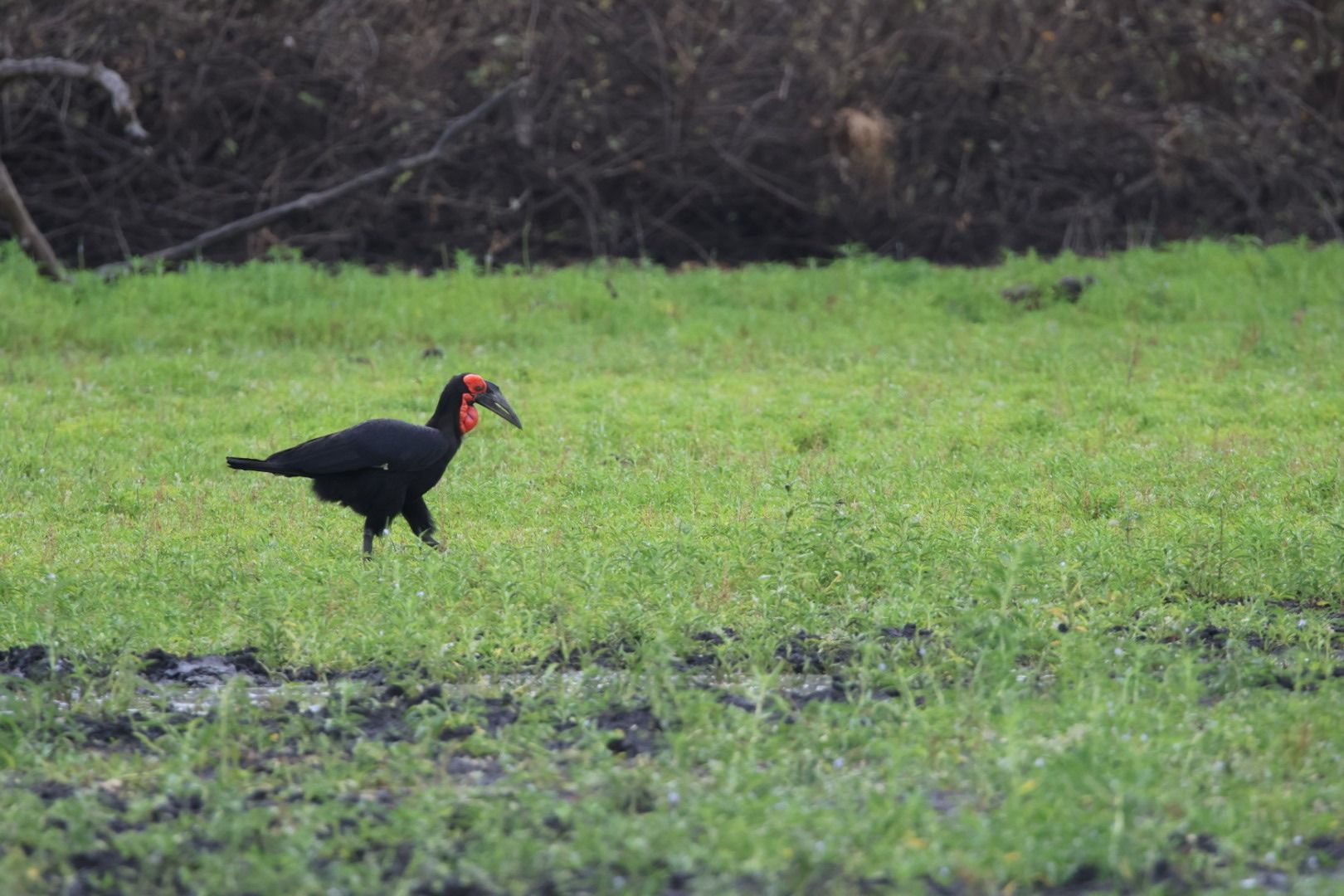
A very large, terrestrial bird with black plumage, a heavy black down-curved bill, and prominent red facial and throat skin. Highly social, living in cooperative breeding groups.
Explore Southern Ground Hornbill in the encyclopedia →Identify your own birds.
Get a report just like this from any photo or call, free.
Plumage & appearance
Adults have entirely black plumage with striking bright red bare skin on the face and throat pouch. The bill is large and black. Juveniles have duller, greyish-black plumage, and their facial skin is initially yellowish or dull grey, gradually turning red over several years.
Key field marks
Massive black body, heavy down-curved bill, bright red naked skin around the eyes and throat, and white wing tips visible only during flight.
Size & weight
Length: 90 to 100 cm; Wingspan: up to 180 cm; Weight: 2.2 to 6.2 kg.
Voice — call & song
Deep, resonant, booming calls that can carry for long distances, often resembling the sound of a distant lion or a steam train.
Diet & foraging
Carnivorous; feeds on insects, reptiles (including venomous snakes), amphibians, small mammals, and occasionally carrion.
Habitat
Savannas, open woodlands, and grasslands with large trees for nesting.
Migration & movement
Non-migratory resident species.
Nesting & breeding
Nests in natural cavities of large mature trees. Lays a clutch of two eggs, but typically only one chick survives due to asynchrony in hatching and sibling competition.
Similar species
Abyssinian Ground Hornbill (Bucorvus abyssinicus), which has blue on the throat patch rather than all red and is found further north in Africa.
Ecological significance
Acts as an apex predator of small vertebrates in its ecosystem, helping control populations of rodents, snakes, and insects.
Conservation status
Vulnerable, with populations declining due to habitat loss, poisoning, and slow reproductive rates.
Observation tips
Look for them walking slowly in open grasslands and savannas, often in small groups. Listening for their deep, booming calls in the early morning is a great way to locate them.
Interesting facts
They are the largest hornbill species in the world and have an extremely slow reproductive rate, raising a single chick only once every three to nine years.
More like this