Order: Bucerotiformes (sometimes classified under Upupiformes), Family: Upupidae
Eurasian Hoopoe
Upupa epops
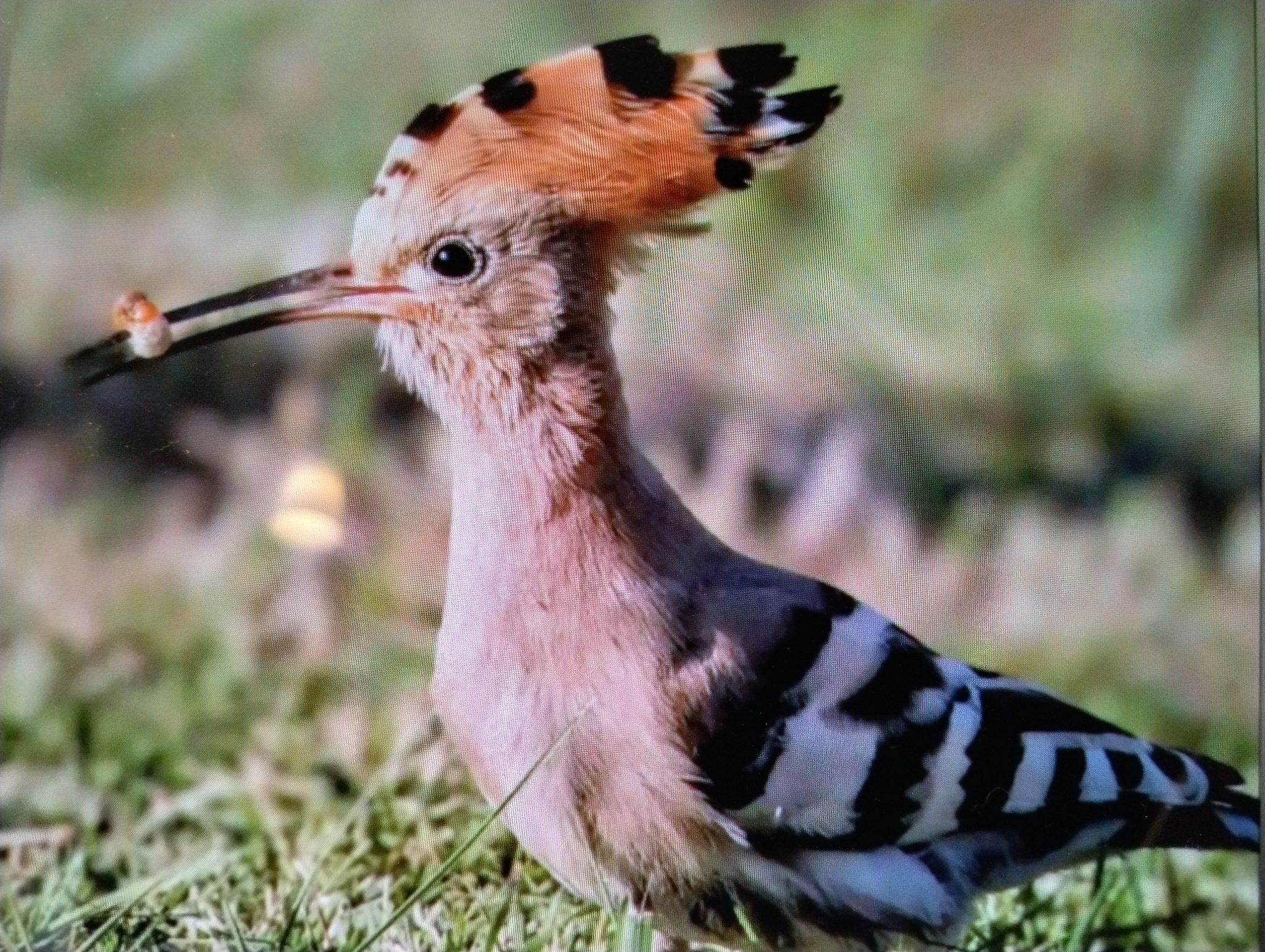
An unmistakable bird with a long, slender down-curved bill, a majestic crest that can be raised and lowered, and a butterfly-like undulating flight pattern.
Explore Eurasian Hoopoe in the encyclopedia →Identify your own birds.
Get a report just like this from any photo or call, free.
Plumage & appearance
Features a striking pinkish-brown or cinnamon body with bold black-and-white barred wings and tail. It has a prominent, fan-like crest of orange-brown feathers tipped with black. Sexes are generally similar, though females may be slightly duller.
Key field marks
The prominent black-tipped orange crest, long curved bill, and striking black-and-white zebra-patterned wings.
Size & weight
Length: 25-32 cm, Wingspan: 44-48 cm, Weight: 46-89 g
Voice — call & song
A distinctive, soft, triple-syllabled hoo-hoo-hoo or pup-pup-pup sound repeated continuously.
Diet & foraging
Primarily insects and their larvae, including crickets, ants, beetles, and cicadas, as well as small reptiles and plant seeds.
Habitat
Prefers open or semi-open country, such as pastures, savannahs, steppes, orchards, and parklands with scattered trees.
Migration & movement
Migratory in the northern parts of its range, wintering in Africa and southern Asia; resident in warmer southern regions.
Nesting & breeding
Nests in natural cavities such as tree hollows or crevices in walls. Lacks a traditional nest structure; lays 4 to 7 eggs, and the female incubates them while being fed by the male.
Similar species
Few species share its distinct crest and coloration. Woodpeckers have similar foraging habits on trees, but lack the elaborate crest and slender curved bill of the hoopoe.
Ecological significance
Helps control agricultural and garden insect pests by consuming large quantities of grubs, beetles, and larvae.
Conservation status
Least Concern, with a stable and widespread population globally.
Observation tips
Look for them walking on short-grass lawns or pastures, probing the ground with their long bills. They can be quite confiding if approached slowly.
Interesting facts
Hoopoes have a unique defense mechanism: nesting females and nestlings can secrete a foul-smelling liquid from their uropygial gland to deter predators.
More like this