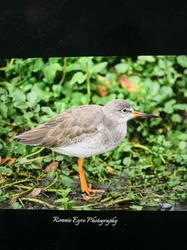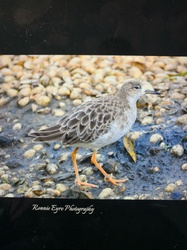
Order: Charadriiformes, Family: Scolopacidae
Sanderling
Calidris alba
A small, plump sandpiper famous for its frantic, mechanical running back and forth along the shoreline following the retreating and advancing waves.
Explore Sanderling in the encyclopedia →Identify your own birds.
Get a report just like this from any photo or call, free.
Plumage & appearance
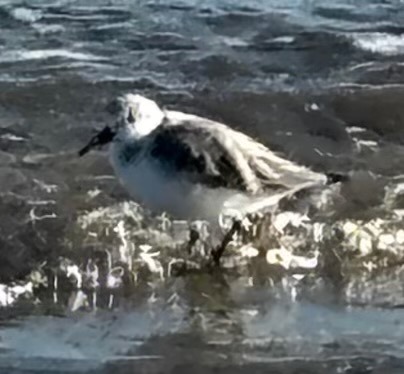
In breeding plumage, has a rusty-red head, neck, and upperparts with dark centers. In non-breeding (winter) plumage, it is very pale, almost silvery-gray above and white below, with a distinctive dark shoulder patch.
Key field marks
Plump body, pale silvery-gray winter plumage, distinct dark 'shoulder' patch at the bend of the wing, short black bill, and rapid running behavior along the surf.
Size & weight
Length: 18-20 cm, Wingspan: 35-39 cm, Weight: 40-100 g
Voice — call & song
A soft, high-pitched, ticking or 'twit' call, often given when flushed or communicating within a flock.
Diet & foraging
Invertebrates such as amphipods, isopods, crabs, marine worms, and insects; occasionally seeds and plant matter on the tundra.
Habitat
Coastal sandy beaches, mudflats, and rocky shores during migration and winter; high Arctic tundra for breeding.
Migration & movement
Long-distance migrant; breeds in the high Arctic and travels far south to coasts across the Americas, Africa, Europe, Asia, and Australia.
Nesting & breeding
Nests on the ground in a shallow scrape lined with leaves and lichen on the high Arctic tundra; clutch is typically 3-4 eggs; both parents participate in incubation and rearing.
Similar species
Semipalmated Sandpiper and Western Sandpiper, but Sanderling is chunkier, paler in winter, lacks webbing on toes to the same degree, and lacks hind toes entirely.
Ecological significance
Acts as an important predator of intertidal invertebrates, helping regulate populations of small crustaceans like mole crabs, and serves as a key migratory prey species for larger raptors and falcons.
Conservation status
Least Concern, with stable populations globally.
Observation tips
Walk slowly along sandy beaches where waves wash ashore. Watch for flocks darting back and forth in unison with the surf, and use binoculars to scan for the characteristic black bill and legs.
Interesting facts
Sanderlings lack a hind toe, an adaptation that helps them run exceptionally fast across the sand. They can reach speeds of up to 35 mph during flight.
More like this