Order: Anseriformes, Family: Anatidae
Egyptian Goose
Alopochen aegyptiaca
An upright, goose-like bird with long legs and a striking facial pattern. They are known for their aggressive and territorial behavior, especially during the breeding season.
Explore Egyptian Goose in the encyclopedia →Identify your own birds.
Get a report just like this from any photo or call, free.
Plumage & appearance
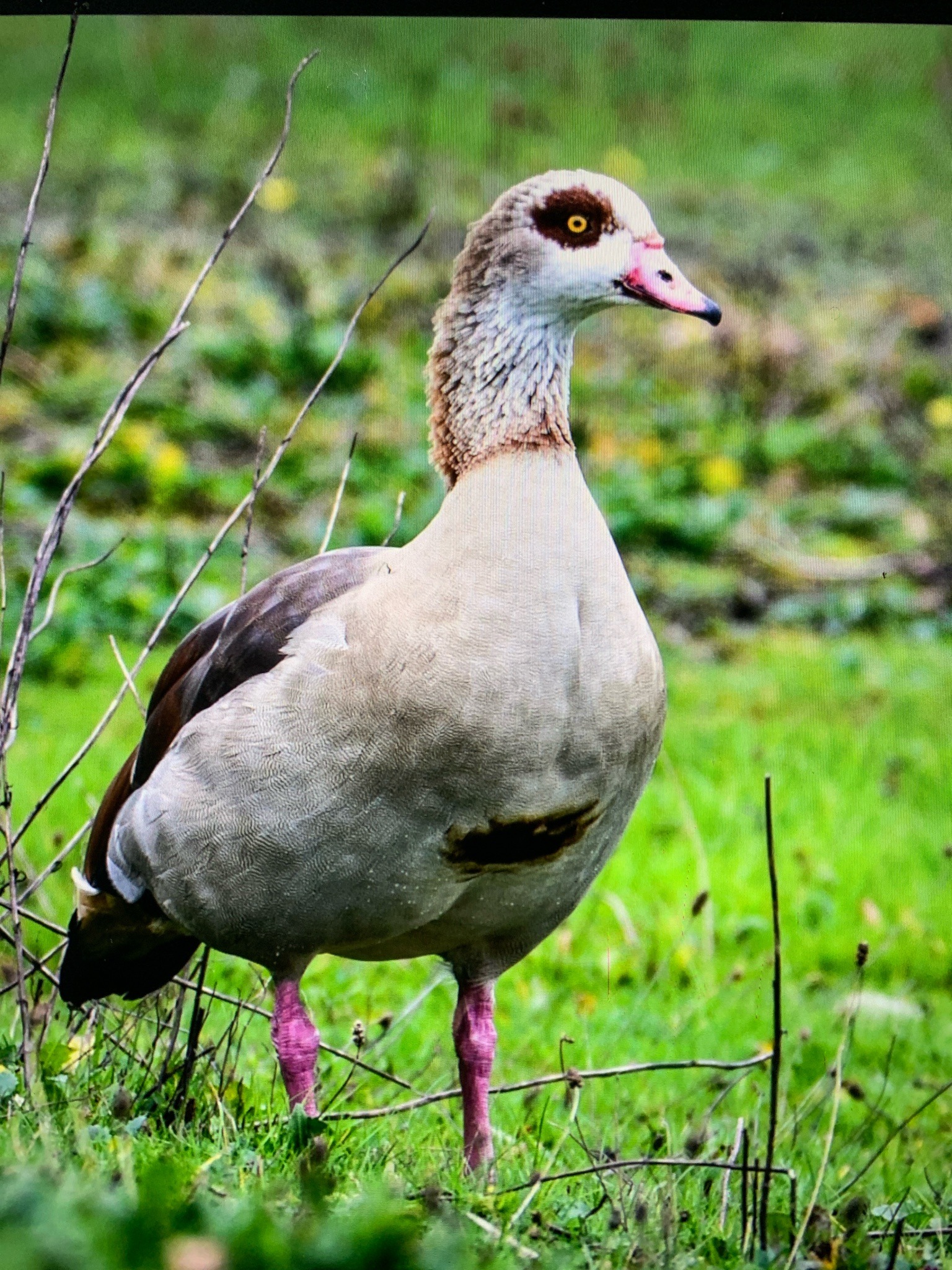
Adults feature a distinctive brown patch around each eye like spectacles, pinkish-red legs and bill, grayish-brown upperparts, and a prominent dark chestnut patch in the center of the pale breast. Sexes are similar in plumage, though males are typically slightly larger.
Key field marks
Dark brown eye patch (spectacle), pink bill and legs, pale grey and brown body with a dark brown chest spot, and large white wing patches visible in flight.
Size & weight
Length: 63-73 cm, Wingspan: 135-145 cm, Weight: 1.5-2.25 kg
Voice — call & song
Noisy birds, especially females which produce a harsh, raucous cackle or honking call; males emit a much softer, breathy hiss.
Diet & foraging
Herbivorous; feeds on grass, leaves, seeds, and occasionally small aquatic insects or worms, often foraging on land in open grassy areas.
Habitat
Found near a wide variety of freshwater wetlands, lakes, rivers, agricultural lands, and open grasslands, frequently venturing onto lawns in urban parks.
Migration & movement
Mostly resident, though local nomadic movements occur in response to rainfall and water availability in parts of Africa.
Nesting & breeding
Nests are typically placed on the ground in dense vegetation, in tree cavities, on cliff ledges, or occasionally in old raptor nests. Clutch size ranges from 5 to 11 eggs, incubated mainly by the female for about 28-30 days.
Similar species
Can be confused with other shelducks or large geese, but the distinct dark eye patches and chestnut breast spot make the Egyptian Goose unmistakable.
Ecological significance
Acts as both herbivore and seed disperser in its wetland and grassland ecosystems, though introduced populations can sometimes compete aggressively with native wildlife.
Conservation status
Least Concern, with a stable and expanding population globally.
Observation tips
Look for them near bodies of water, agricultural fields, or urban parks. They are quite bold and often easy to approach closely, but watch out for territorial displays.
Interesting facts
Ancient Egyptians considered the Egyptian Goose sacred and frequently depicted it in their artwork and hieroglyphs. Despite being called a goose, it is actually a type of shelduck.
More like this