Order: Passeriformes, Family: Fringillidae
Lesser Goldfinch
Spinus psaltria
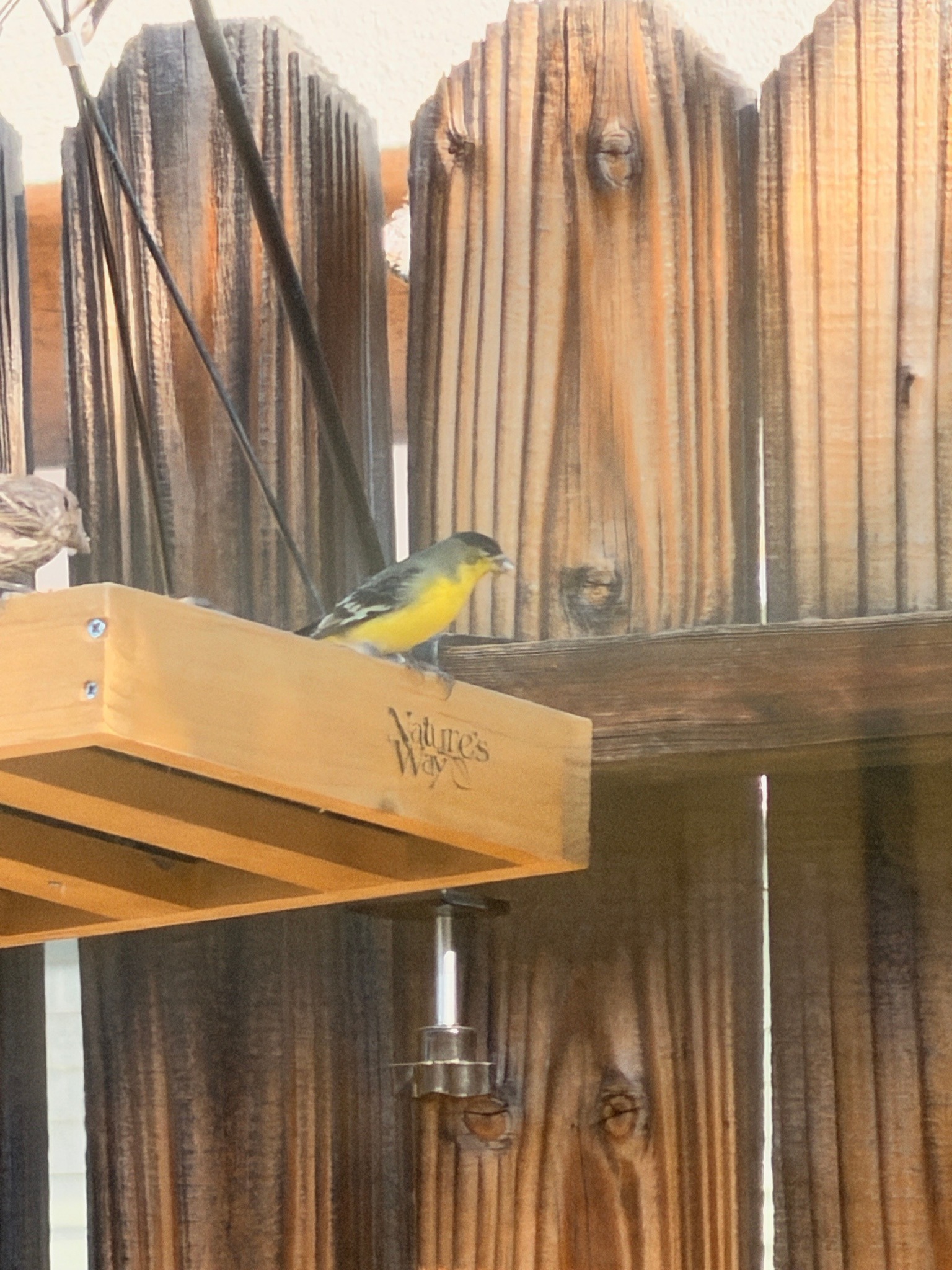
A very small, active finch with a stout, conical bill, bright yellow underparts, and dark wings with white wingbars. They are social birds, often seen foraging in small flocks.
Explore Lesser Goldfinch in the encyclopedia →Identify your own birds.
Get a report just like this from any photo or call, free.
Plumage & appearance
Adult males in the western race have a glossy black cap, bright yellow underparts, and an olive-green back with distinctive white patches on the wings. Eastern birds often have a black back instead of green. Females and juveniles are duller, lacking the black cap, with olive-green upperparts, yellowish underparts, and less pronounced wing markings.
Key field marks
Bright yellow underparts, black cap (males), dark wings with white wingbars, and a short, conical pale bill.
Size & weight
Length: 9.5-12 cm (3.7-4.7 in); Wingspan: 15-20 cm (5.9-7.9 in); Weight: 8-12 g (0.3-0.4 oz)
Voice — call & song
A rich, musical song consisting of a series of warbles, trills, and sometimes mimicry of other species. Their most common call is a distinctive, plaintive, downward-sloping 'tee-dee' or 'chur-ee'.
Diet & foraging
Primarily granivorous, feeding on seeds from weeds like dandelions, sunflowers, and thistles. They also eat buds, tree sap, and occasionally small insects.
Habitat
Open country, scrub, desert edges, riparian woodlands, oak savannas, and suburban gardens or parks.
Migration & movement
Mainly a permanent resident, though some northernmost populations make short-distance seasonal movements.
Nesting & breeding
Builds an open, cup-shaped nest made of plant fibers, spiderwebs, and down, typically placed in the fork of a tree or shrub. Clutch size is usually 3 to 5 pale bluish-white eggs. Incubated by the female for about 12-13 days.
Similar species
American Goldfinch (males lack the dark back/cap and have orange-pinkish bills in winter; Lesser Goldfinch has a darker back and gray bill); Lawrence's Goldfinch (grayer overall with yellow breast and black face mask).
Ecological significance
Acts as an important seed disperser and helps control weed populations through its diet. They are also prey for various small raptors and shrikes.
Conservation status
Least Concern, with a stable population trend.
Observation tips
Look for them at backyard bird feeders offering Nyjer (thistle) seed or sunflower chips. They are also frequently spotted in weedy fields feeding on dandelion and thistle seeds.
Interesting facts
Lesser Goldfinches are one of the latest-nesting songbirds in North America, often waiting until late summer when thistles and other seed-producing plants are mature and going to seed.
More like this