Order: Anseriformes, Family: Anatidae
Emperor Goose
Anser canagicus
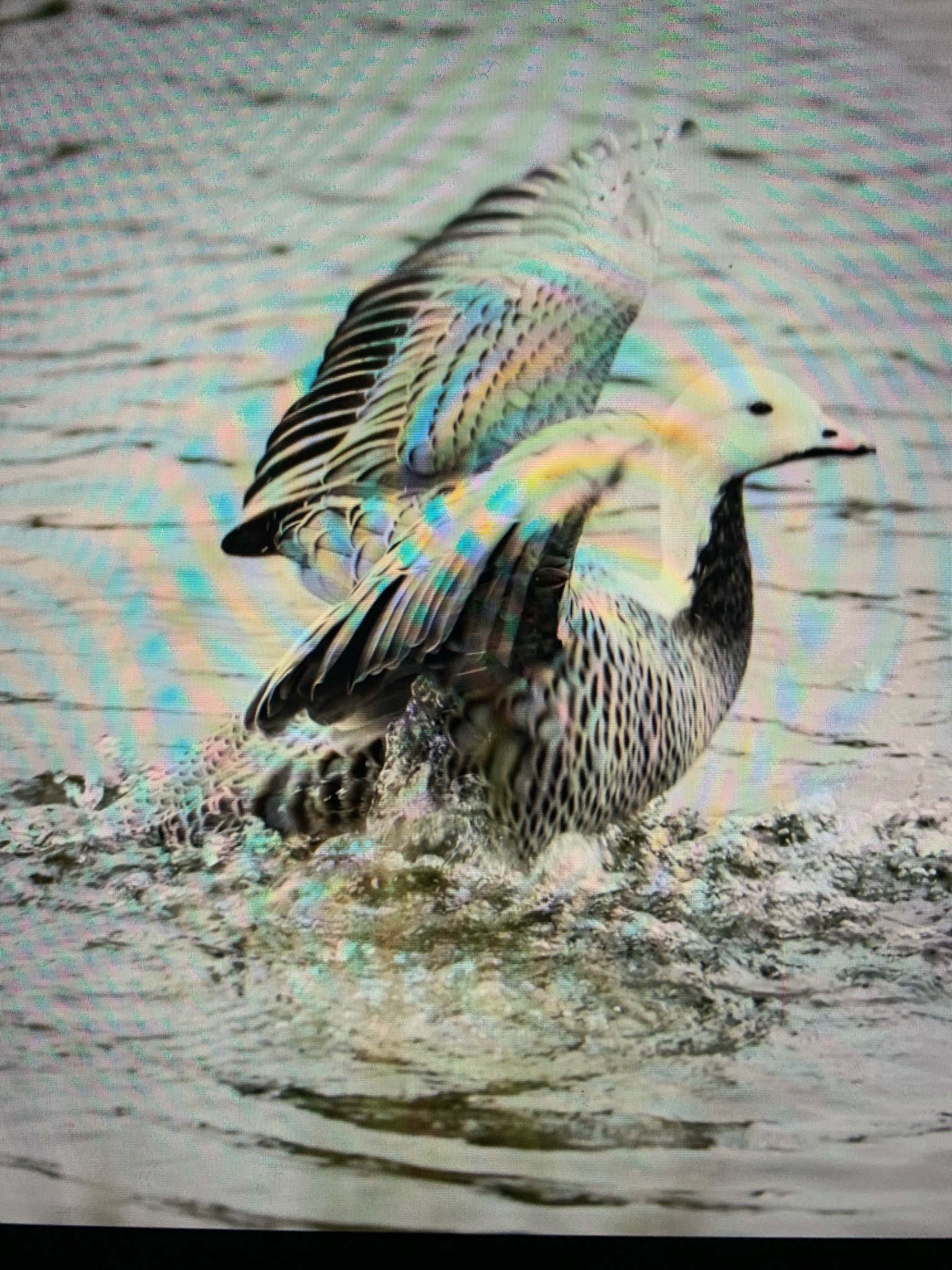
A striking, medium-sized goose with a distinctive white head, dark throat, and scaly-appearing bluish-gray barred body. They are social birds, often found in small flocks along marine coastlines.
Explore Emperor Goose in the encyclopedia →Identify your own birds.
Get a report just like this from any photo or call, free.
Plumage & appearance
Adults have a white head and hindneck, often stained yellowish by iron in the water, and a black chin and throat. The body is bluish-gray with prominent black-and-white barring. The tail is white, and the legs are bright orange. Juveniles have darker heads with grayish-brown mottling and less distinct barring.
Key field marks
White head and hindneck, black chin/throat, dark bluish-gray barred body, and bright orange legs.
Size & weight
Length: 60-70 cm (24-28 in); Wingspan: 110-120 cm (43-47 in); Weight: 2.2-3.4 kg (4.8-7.5 lbs)
Voice — call & song
A high-pitched, musical, two-syllable honk or cackle, often described as a clearer and higher version of the Greater White-fronted Goose call.
Diet & foraging
Primarily vegetarian, feeding on coastal grasses, sedges, eelgrass, algae, and occasionally marine invertebrates such as mollusks and crustaceans during winter.
Habitat
Maritime tundra, tidal flats, estuaries, and rocky marine coastlines. They rarely venture far inland or into freshwater habitats compared to other geese.
Migration & movement
Short-distance migrant; moves from tundra breeding grounds to ice-free marine waters in the Aleutian Islands and south-central Alaska for the winter.
Nesting & breeding
Nests on the ground near water in coastal tundra, using a shallow depression lined with plant material and down. Clutch size typically ranges from 3 to 7 eggs. Females incubate while males stand guard.
Similar species
Snow Goose, which is entirely white (except for black wingtips) and lacks the bluish-gray barred body of the Emperor Goose.
Ecological significance
Acts as a seed disperser and plays a role in coastal nutrient cycling. Overgrazing can impact local tundra vegetation, though they generally maintain a balanced relationship with their habitat.
Conservation status
Near Threatened. Populations have faced historical declines due to hunting, lead poisoning, and mammalian predation, though some recovery has been observed.
Observation tips
Best observed along remote Alaskan coastal mudflats, estuaries, and rocky shores during the summer breeding season or wintering grounds in the Aleutians.
Interesting facts
The Emperor Goose has one of the most restricted geographic ranges of any goose species, being almost entirely confined to the Bering Sea region.
More like this