Order: Apodiformes, Family: Trochilidae
Mexican Violetear
Colibri thalassinus
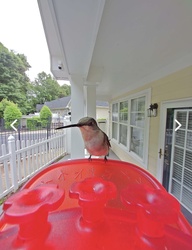
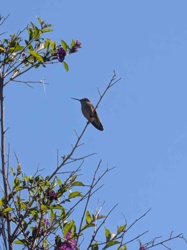
A medium-sized hummingbird recognized by its vibrant green plumage and glowing violet ear patches, often showing aggressive and territorial behavior at flowering plants and feeders.
Explore Mexican Violetear in the encyclopedia →Identify your own birds.
Get a report just like this from any photo or call, free.
Plumage & appearance
Brilliant sparkling green body with a striking violet-blue patch (ear tuft) extending from behind the eye down the side of the neck. The lower back and tail are shimmering blue-green, with a broad dark subterminal band on the rounded tail. Sexes are similar, though females may be slightly duller.
Key field marks
Brilliant green overall coloration, prominent violet-blue ear patch, and a slightly curved black bill with a rounded tail featuring a dark subterminal band.
Size & weight
Length: 9.7 to 12 cm (3.8 to 4.7 inches), Wingspan: approximately 14 to 15 cm, Weight: 4.8 to 5.6 grams.
Voice — call & song
A repeated, metallic, high-pitched chip or ticking call, often delivered persistently from a prominent perch.
Diet & foraging
Primarily feeds on nectar from a variety of flowering plants and supplements its diet with small insects caught in flight or gleaned from foliage.
Habitat
Subtropical or tropical moist montane forests, heavily degraded former forest, and high-elevation shrublands and gardens.
Migration & movement
Mostly resident, though some populations undertake altitudinal migrations and individuals frequently wander north outside of the breeding season.
Nesting & breeding
Builds a small, cup-shaped nest out of plant fibers and spider silk placed on a horizontal branch or twig, usually in a protected forest edge. Clutch size is typically 2 white eggs.
Similar species
Lesser Violetear, which is smaller, has a more restricted violet patch, and is found further south in South America.
Ecological significance
Acts as an important pollinator for numerous flowering plants and trees throughout its highland forest range.
Conservation status
Least Concern, with a stable population trend.
Observation tips
Look for them at mid-to-high elevations in montane forests, forest edges, and gardens with flowering feeders. They are bold and often perch conspicuously on exposed branches.
Interesting facts
Mexican Violetears are known for their loud, mechanical-sounding song and can be surprisingly dominant and territorial over rich nectar sources, sometimes chasing away much larger birds.
More like this