Order: Apodiformes, Family: Trochilidae
Mexican Violetear
Colibri thalassinus
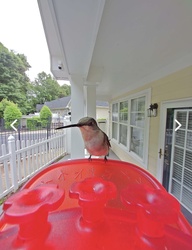
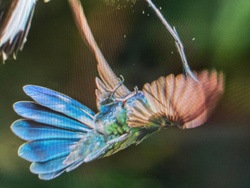
A medium-sized hummingbird known for its iridescent green and violet coloration. Extremely agile in flight, capable of hovering and flying backwards, often holding its wings open momentarily after landing.
Explore Mexican Violetear in the encyclopedia →Identify your own birds.
Get a report just like this from any photo or call, free.
Plumage & appearance
Predominantly bright metallic green body with a striking, deep violet-blue ear patch extending down the sides of the neck. The tail is bright blue-green with a distinct dark subterminal band. Males and females look very similar, though females are slightly smaller and duller.
Key field marks
Brilliant green plumage, striking violet-blue ear patch, and a square-ish tail with a dark subterminal band.
Size & weight
Length: 3.8 to 4.8 inches (9.7 to 12.2 cm); Wingspan: approximately 6 to 7 inches; Weight: 4.8 to 5.6 grams.
Voice — call & song
A repetitive, metallic ticking or chipping call (tsip or chip), delivered in rapid series, especially when defending territory.
Diet & foraging
Nectar from flowering plants, supplemented by small insects and spiders caught in mid-air or plucked from foliage.
Habitat
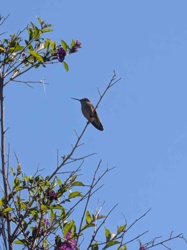
Humid and semi-humid montane forests, forest edges, clearings, and agricultural areas with flowering shrubs, typically at elevations between 1,500 and 3,000 meters.
Migration & movement
Mostly resident, though some populations undergo altitudinal migrations, moving to lower elevations during the non-breeding season.
Nesting & breeding
Constructs a small, cup-shaped nest out of plant fibers, moss, and spiderwebs, placed on a low, horizontal tree branch. The female lays two white eggs and raises the young independently.
Similar species
Sparkling Violetear (Colibri coruscans), which has a more extensive violet patch extending over the crown; Lesser Violetear, which is smaller and separated by range.
Ecological significance
Acts as an important pollinator for numerous flowering plants and trees in montane forests, aiding in plant reproduction and maintaining biodiversity.
Conservation status
Least Concern (Stable population trend)
Observation tips
Look for them visiting tubular flowers in mountain gardens, forest edges, or at hummingbird feeders. They can be quite aggressive and territorial around food sources.
Interesting facts
Mexican Violetears are known for their loud, buzzing vocalizations and high-energy territorial displays, often driving away much larger birds from choice feeding territories.
More like this