Order: Sphenisciformes, Family: Spheniscidae
Gentoo Penguin
Pygoscelis papua
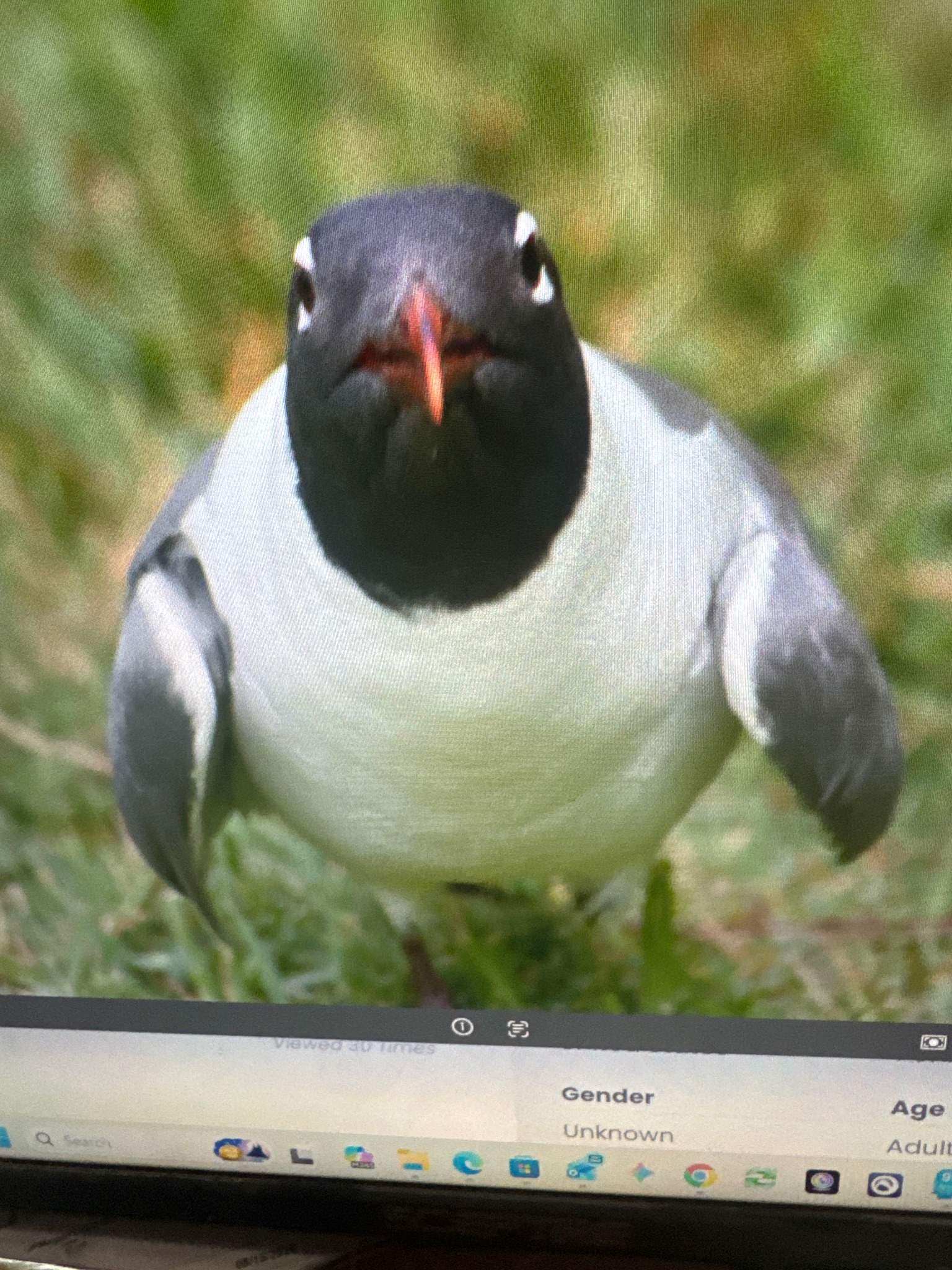
A stout, medium-large penguin easily recognized by its bright orange-red bill and the prominent white 'bonnet' patches on its head. They are famously fast swimmers and have a somewhat comical, upright waddling gait on land.
Explore Gentoo Penguin in the encyclopedia →Identify your own birds.
Get a report just like this from any photo or call, free.
Plumage & appearance
Adults have a distinctive white triangular patch extending above each eye, connected by a narrow white band across the crown. The head, throat, and back are black, with a stark white belly and underparts. Flippers are black and white. Juveniles have a paler, more mottled grey head and lack the prominent white eye patches of adults.
Key field marks
Bright orange-red bill with a slightly curved black upper mandible tip, striking white triangular patches above the eyes, white belly, and a long, prominent tail which is more noticeable than in other penguins.
Size & weight
Length: 51 to 90 cm (20 to 35 in). Weight: 4.5 to 8.5 kg (10 to 19 lbs), with males generally larger than females.
Voice — call & song
Emit a variety of loud, trumpeting calls, squawks, and high-pitched piping sounds, especially during courtship and territorial displays.
Diet & foraging
Primarily opportunistic feeders, consuming a mix of krill, squid, and small fish. They forage mainly in benthic coastal waters.
Habitat
Coastal marine environments, breeding on ice-free rocky plains, coastal slopes, and raised beaches.
Migration & movement
Primarily sedentary/resident. They generally remain near their breeding colonies year-round, though they may disperse locally during harsh winter conditions.
Nesting & breeding
Breed in colonies on ice-free ground, constructing circular nests out of small stones, twigs, and vegetation. Typically lay a clutch of two eggs. Both parents share incubation duties (lasting about 35 days) and chick-rearing.
Similar species
Can be confused with other brush-tailed penguins (Pygoscelis genus) such as the Chinstrap Penguin and Adélie Penguin. The Gentoo is easily distinguished by its bright orange-red bill and white head patch, lacking the black chin strap of the Chinstrap and the all-black head of the Adélie.
Ecological significance
As top marine predators in the Southern Ocean, Gentoo Penguins play a crucial role in regulating marine food webs, particularly krill and fish populations. Their guano also provides essential nutrients to terrestrial coastal ecosystems.
Conservation status
Least Concern, with a generally stable or increasing global population trend, though local colonies face pressures from climate change and commercial fishing.
Observation tips
Gentoo penguins are relatively approachable at breeding colonies, but observers should maintain a respectful distance (at least 15 meters) to avoid causing stress. A telephoto lens is ideal for close-up portraits without disturbing them.
Interesting facts
Gentoo penguins are recognized as the fastest underwater swimming penguins, capable of reaching speeds up to 36 km/h (22 mph). They are also known to be quite vocal and form lifelong pair bonds.
More like this