Order: Ciconiiformes, Family: Ciconiidae
Wood Stork
Mycteria americana
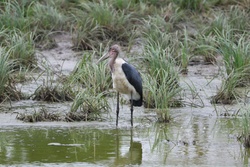
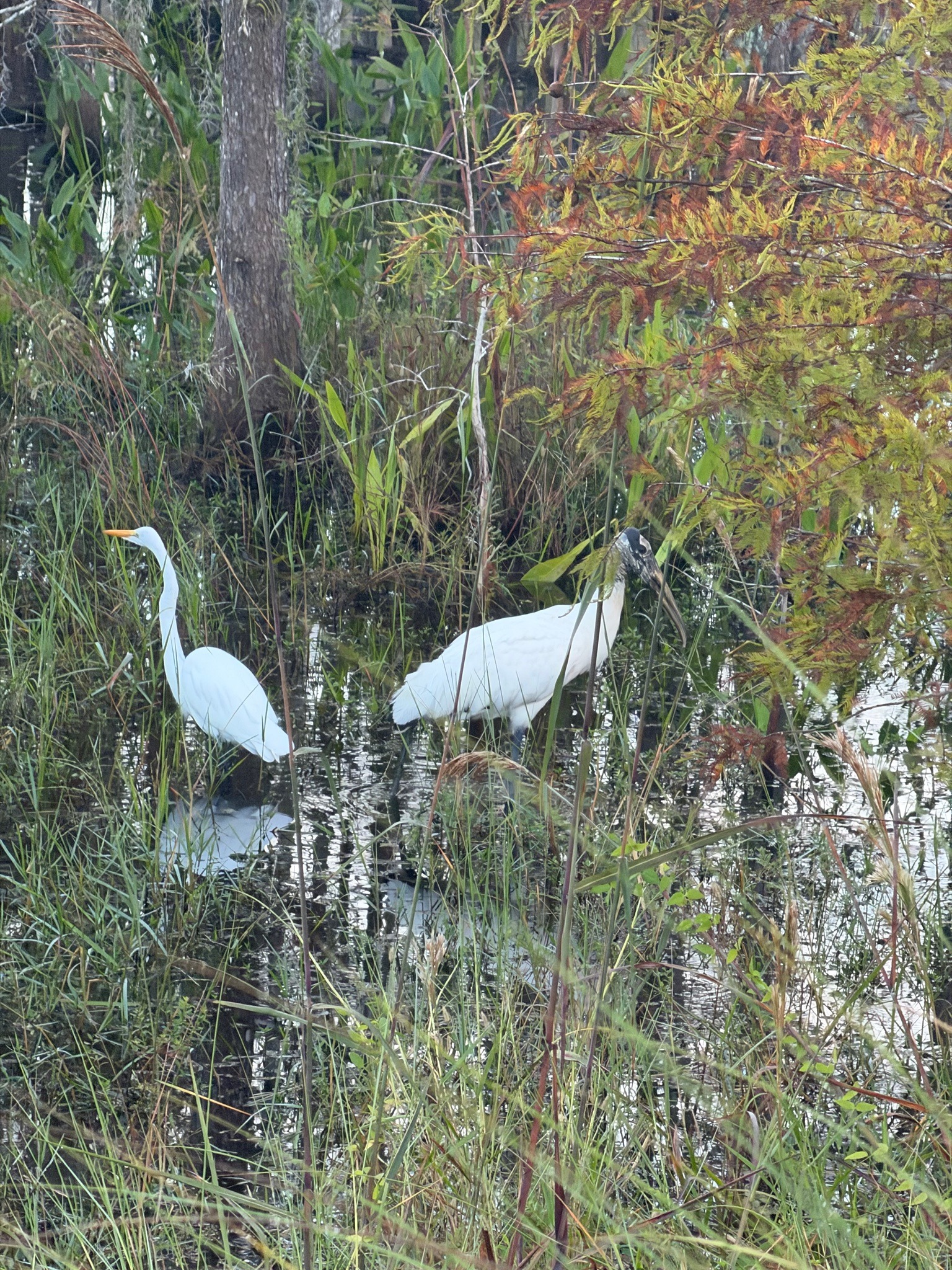
A large wading bird with a heavy, down-curved dark bill, unfeathered dark head, and long legs. They often soar high in thermal updrafts like raptors.
Explore Wood Stork in the encyclopedia →Identify your own birds.
Get a report just like this from any photo or call, free.
Plumage & appearance
Adults have predominantly white plumage with contrasting black flight feathers (primaries and secondaries) and a black tail. The head and upper neck are bare and dark gray to black. Juveniles have duller grayish necks with some feathering on the crown and a yellowish bill.
Key field marks
Large white body, distinctive dark scaly head and neck, heavy curved bill, long dark legs, and black tail and wingtips.
Size & weight
Length: 85-105 cm (33-41 in); Wingspan: 150-180 cm (59-71 in); Weight: 2-3 kg (4.4-6.6 lbs).
Voice — call & song
Generally silent except at the nesting colony, where they produce low croaking sounds, hisses, and bill-clattering displays.
Diet & foraging
Primarily small fish (such as sunfish and minnows), as well as frogs, snakes, and large aquatic invertebrates. They use tactile foraging, sweeping their slightly open bills through water to sense prey.
Habitat
Freshwater and brackish wetlands, swamps, cypress ponds, flooded pastures, and mangrove swamps.
Migration & movement
Mainly resident, though northern populations in the US may disperse widely northward after the breeding season.
Nesting & breeding
Nests in colonies high in trees (often cypress or mangroves) over standing water. Females lay a clutch of 3 to 5 eggs. Both parents incubate the eggs and feed the altricial chicks.
Similar species
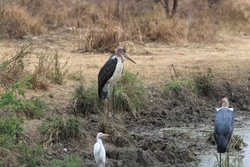
Great Egret (seen standing beside the wood stork in the image) and American White Ibis. The wood stork is easily distinguished by its heavy, decurved dark bill, unfeathered dark head, and black flight feathers.
Ecological significance
Wood storks act as apex predators in aquatic food webs, and their nesting success is considered an important bioindicator of the health of wetland ecosystems, particularly the Florida Everglades.
Conservation status
IUCN Least Concern globally, though historically listed as Endangered in the US due to habitat loss; populations have recovered sufficiently in recent decades to be downlisted to Threatened.
Observation tips
Look for them in shallow wetlands, swamps, and flooded agricultural fields. Because they soar in circles high in the sky, scanning overhead on warm days can be productive.
Interesting facts
The wood stork is the only species of stork that regularly breeds in North America. They rely on drying pools where fish become concentrated to feed efficiently enough to support raising young.
More like this