Order: Ciconiiformes, Family: Ciconiidae
White Stork
Ciconia ciconia
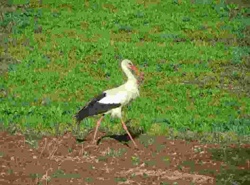
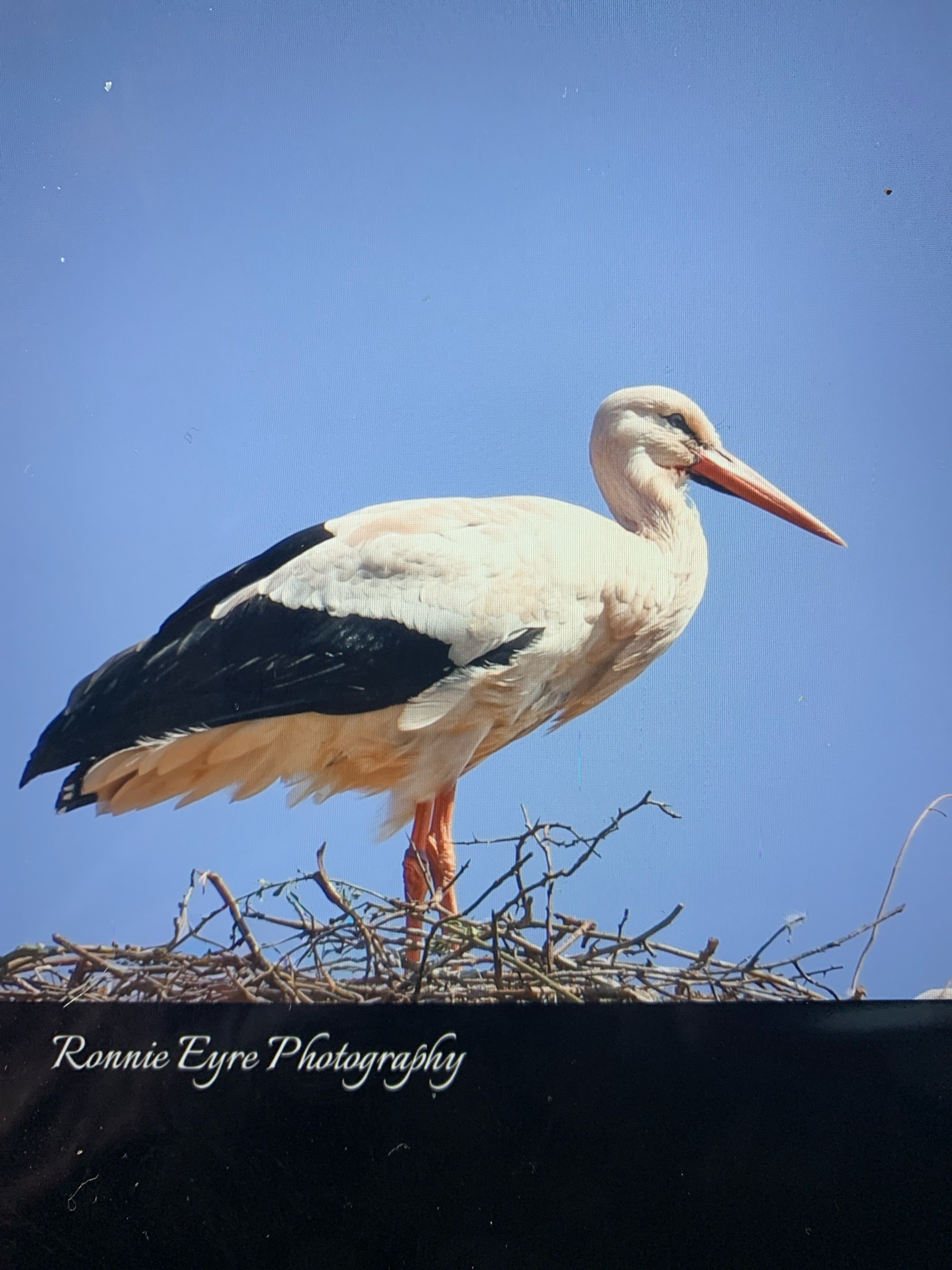
A very large wading bird with long red legs, a long pointed red bill, and a contrasting black and white plumage. Known for its graceful flight with neck fully extended and large stick nests.
Explore White Stork in the encyclopedia →Identify your own birds.
Get a report just like this from any photo or call, free.
Plumage & appearance
Adults have mostly white plumage with striking black flight feathers (remiges and primary coverts). The bill and long legs are red. Juveniles are similar but have duller, brownish-black flight feathers and a dark-tipped bill.
Key field marks
White body, black wings visible in flight or folded at rest, long red legs, and long red straight bill. Neck is extended straight out during flight, distinguishing them from herons which curve their necks.
Size & weight
Length: 100-115 cm, Wingspan: 155-215 cm, Weight: 2.3-4.5 kg
Voice — call & song
Generally silent except for bill-clattering (bill-snapping), which sounds like a wooden rattle and is used for communication at the nest.
Diet & foraging
Carnivorous, eating insects, fish, amphibians, reptiles, small mammals, and small birds, foraging primarily by walking slowly through damp meadows and shallow wetlands.
Habitat
Open agricultural land, grasslands, pastures, and shallow wetlands, often nesting near human habitation.
Migration & movement
Long-distance migrant; western populations migrate via Gibraltar over Africa, while eastern populations use the Bosphorus over the Middle East.
Nesting & breeding
Builds massive stick nests on trees, cliffs, rooftops, chimneys, or poles, reusing and adding to them over many years. Clutch size is typically 4 eggs. Both parents incubate and feed the young.
Similar species
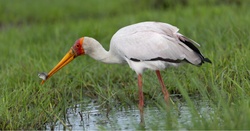
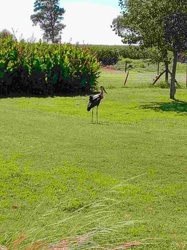
Black Stork (Ciconia nigra) has completely dark brown/black plumage except for a white belly. Oriental Stork (Ciconia boyciana) is larger with a black bill. Yellow-billed Stork has a yellow bill and pink face.
Ecological significance
Acts as an apex predator of small terrestrial vertebrates and large insects, helping control rodent and insect populations in agricultural and wetland ecosystems.
Conservation status
Least Concern (LC), with a generally stable or increasing population trend globally due to conservation and feeding support.
Observation tips
Look for them standing in agricultural fields, meadows, or perched on high artificial structures like utility poles, chimneys, and specially erected nesting platforms in rural European villages.
Interesting facts
Famous in folklore as the bird that brings human babies. They are monogamous and often return to the exact same nest and partner year after year.
More like this