Order: Coraciiformes, Family: Meropidae
Blue-cheeked Bee-eater
Merops persicus
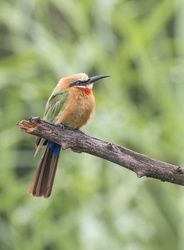
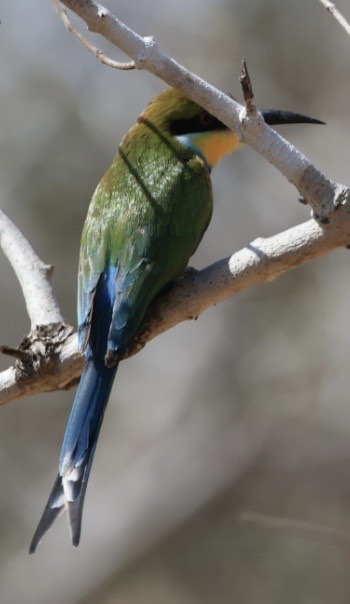
A slender, colorful bird with a slightly downcurved black bill, striking blue cheeks, and prominent elongated central tail feathers. Highly gregarious and an expert aerial hunter.
Explore Blue-cheeked Bee-eater in the encyclopedia →Identify your own birds.
Get a report just like this from any photo or call, free.
Plumage & appearance
Predominantly green plumage with blue cheeks, a yellow and brown throat patch, a black eye stripe, and elongated central tail streamers. Sexes are similar, though juveniles are duller with less distinct tail streamers.
Key field marks
Green body, blue cheeks, yellow throat transitioning to brownish-orange, black eye mask, slender black downcurved bill, and long central tail feathers.
Size & weight
Length: 24-30 cm including tail streamers; Wingspan: 46-49 cm; Weight: 30-57 g
Voice — call & song
A liquid, rolling trill or series of rolling 'prree-prree' notes, often given in flight.
Diet & foraging
Insects, predominantly flying insects like bees, wasps, hornets, and dragonflies, caught on the wing.
Habitat
Open country, semi-deserts, agricultural lands, river valleys, and savannahs, usually near open water sources.
Migration & movement
Strongly migratory, traveling in flocks between breeding grounds in Eurasia/North Africa and wintering grounds in sub-Saharan Africa.
Nesting & breeding
Nests colonially in burrows excavated in sandy banks or flat sandy ground. Lays a clutch of 4 to 8 white eggs, incubated by both parents.
Similar species
European Bee-eater (Merops apiaster), which features more vibrant yellow and chestnut upperparts and lacks the distinct extensive blue cheeks of the Blue-cheeked Bee-eater.
Ecological significance
Acts as an important natural controller of insect populations, particularly agricultural pests such as dragonflies, bees, and wasps.
Conservation status
Least Concern, with a stable global population trend.
Observation tips
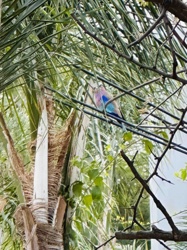
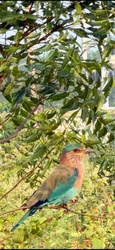
Look for them perched prominently on bare branches, wires, or fence posts near water or open country, making frequent aerial sallies to catch insects.
Interesting facts
Bee-eaters remove the sting from venomous insects before eating them by repeatedly rubbing the insect against a hard surface.
More like this