Order: Coraciiformes, Family: Meropidae
Rainbow Bee-eater
Merops ornatus
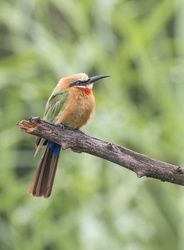
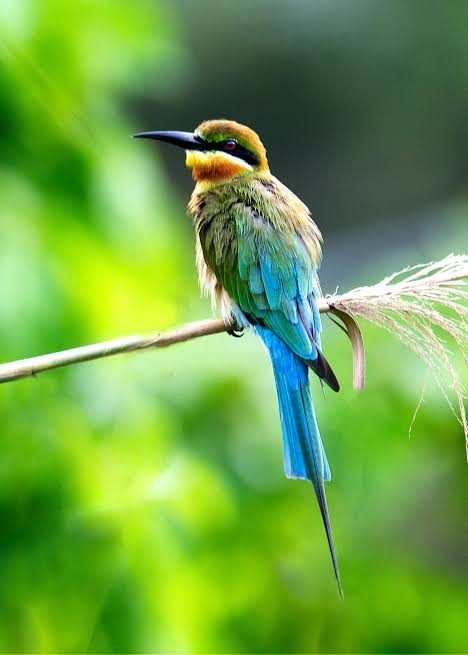
A brilliantly colorful, slender bird with a slightly downcurved black bill, red eyes, and distinctive elongated central tail streamers. Known for its acrobatic flight and insect-catching prowess.
Explore Rainbow Bee-eater in the encyclopedia →Identify your own birds.
Get a report just like this from any photo or call, free.
Plumage & appearance
Features a black eye-stripe, yellow throat bordered with black, rufous-brown crown and nape, green back and wings, and pale blue rump. The underparts are green-blue. Tail feathers are mostly blue-black with two elongated central streamers, which are longer in males.
Key field marks
Black eye mask, bright yellow throat with a black collar, green and blue plumage, and the two long, thin central tail streamers.
Size & weight
Length: 23-28 cm including tail streamers; Wingspan: approximately 30-35 cm; Weight: 20-30 grams
Voice — call & song
A series of liquid, rolling, musical trills and soft, repetitive twittering notes given frequently in flight.
Diet & foraging
Insects caught on the wing, predominantly bees and wasps. They remove the sting by repeatedly beating the insect against a hard surface before consumption.
Habitat
Open country with suitable scattered trees, lightly timbered ridges, sandy areas for nesting, and often found near watercourses in forest, woodland, shrubland, and agricultural land.
Migration & movement
Partial migrant. Birds in southern Australia migrate north to the tropics and nearby islands for the southern winter, returning in spring to breed.
Nesting & breeding
Excavates a long, horizontal tunnel ending in a nesting chamber dug into sandy banks, soil mounds, or flat ground. Lays a clutch of 3 to 7 white spherical eggs. Both parents share incubation and chick-rearing duties.
Similar species
Few other Australian birds share this combination of bright colors and long tail streamers. The Blue-cheeked Bee-eater is found in Europe, Africa, and Asia but rarely overlaps in range.
Ecological significance
Acts as an important natural controller of insect populations, particularly agricultural pests such as bees, wasps, dragonflies, and beetles.
Conservation status
Least Concern, with a stable and widespread population trend
Observation tips
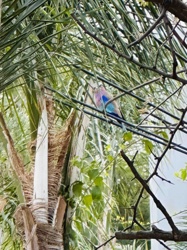
Look for them perched prominently on dead branches, overhead power lines, or wire fences near water sources or sandy banks where they hunt. Patience pays off as they frequently return to the exact same perch.
Interesting facts
Rainbow Bee-eaters are highly social birds that often roost communally in dense foliage and sometimes dig communal nesting tunnels. Despite eating stinging insects, they are largely immune to bee and wasp stings once processed.
More like this