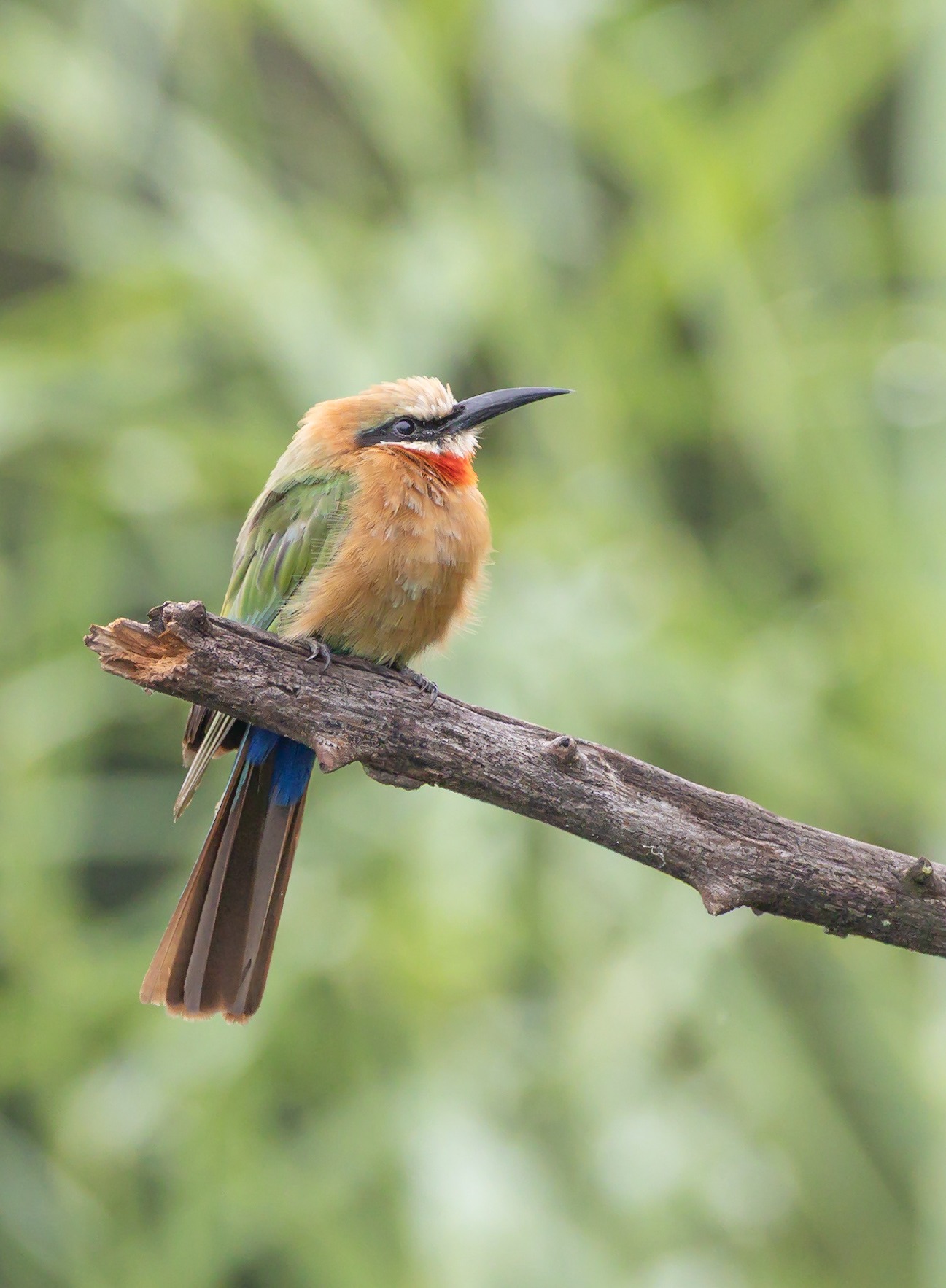
Order: Coraciiformes, Family: Meropidae
White-fronted Bee-eater
Merops bullockoides
A colorful, social bird often seen perched on low branches near water. It is known for its complex social structure and acrobatic flight while hunting insects.
Explore White-fronted Bee-eater in the encyclopedia →Identify your own birds.
Get a report just like this from any photo or call, free.
Plumage & appearance
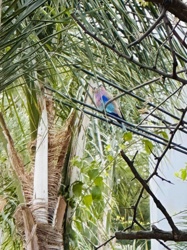
Features a white forehead and throat, a distinctive red patch on the lower throat, and a black mask through the eyes. The upperparts are green, the underparts are buff/cinnamon, and the tail is blue and green. Sexes are similar in appearance.
Key field marks
Distinctive white forehead and bib, bright red patch on the throat, and lack of long central tail streamers compared to many other bee-eaters.
Size & weight
Length: 23 cm (9 in); Weight: 28-38 grams.
Voice — call & song
A various range of nasal 'ga-raa' or 'squawk' notes; social groups are often very noisy.
Diet & foraging
Strictly insectivorous; feeds primarily on bees, wasps, and hornets, which it catches mid-air.
Habitat
Savannas, open woodlands, and bushy pastures, almost always near rivers or gullies with high banks for nesting.
Migration & movement
Mainly resident or local nomad; they do not undertake long-distance migrations but may move according to water availability.
Nesting & breeding
Colonial nesters that dig burrows into sandy banks. They exhibit a complex 'extended family' system where non-breeding birds help raise the chicks of the dominant pair.
Similar species
Little Bee-eater (smaller, lacks white forehead and red throat), White-throated Bee-eater (has different head markings and longer tail streamers).
Ecological significance
Controls insect populations, particularly bees and wasps. They are unusual for having a 'helper' system at the nest, providing a model for studying avian social cooperation.
Conservation status
Least Concern (IUCN); population trend is stable.
Observation tips
Look for them near riverbanks with sandy cliffs or vertical soil banks where they nest in colonies. They are often approachable near water holes.
Interesting facts
To eat a stinging insect, the bird beats it against a branch to remove the stinger and express the venom before swallowing. They live in colonies of up to 200 individuals.
More like this