Order: Coraciiformes; Family: Alcedinidae
Identified from audio
Common Kingfisher
Alcedo atthis
A small, brightly colored bird known for its lightning-fast dives into water to catch fish. It has a large head, short tail, and a long, dagger-like bill.
Explore Common Kingfisher in the encyclopedia →Identify your own birds.
Get a report just like this from any photo or call, free.
Plumage & appearance
Brilliant azure-blue upperparts, bright orange underparts, and a white throat and neck patch. Females have an orange-red patch on the lower mandible (beak), whereas males have a solid black bill.
Key field marks
Electric blue back and head, rufous ear coverts, bright orange belly, and white neck blaze.
Size & weight
Length: 16-17 cm; Wingspan: 24-26 cm; Weight: 34-46 g
Voice — call & song
As heard in the recording, the call is a sharp, high-pitched 'tsee' or 'tsee-it,' often repeated while in flight.
Diet & foraging
Primarily small fish (such as minnows and sticklebacks), as well as aquatic insects and crustaceans.
Habitat
Slow-moving rivers, canals, lakes, and coastal areas with abundant small fish and suitable nesting banks.
Migration & movement
Mostly resident in Western Europe; birds from colder regions in Russia and Scandinavia migrate south for the winter.
Nesting & breeding
Digs tunnels into vertical sandy or loamy riverbanks, ending in a nesting chamber where 5-7 eggs are laid.
Similar species
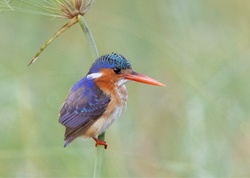
Malachite Kingfisher (found in Africa, smaller), Azure Kingfisher (found in Australia).
Ecological significance
Acts as an indicator species for water quality and ecosystem health, as it requires clear water and healthy fish populations.
Conservation status
Least Concern (IUCN)
Observation tips
Look for them perched motionless on low branches overhanging slow-moving water. Listen for their sharp, high-pitched whistle as they fly low and fast.
Interesting facts
Common Kingfishers must eat about 60% of their body weight daily. They have specialized eyes that can see clearly both in air and underwater.
More like this