Order: Coraciiformes; Family: Alcedinidae
Malachite Kingfisher
Corythornis cristatus
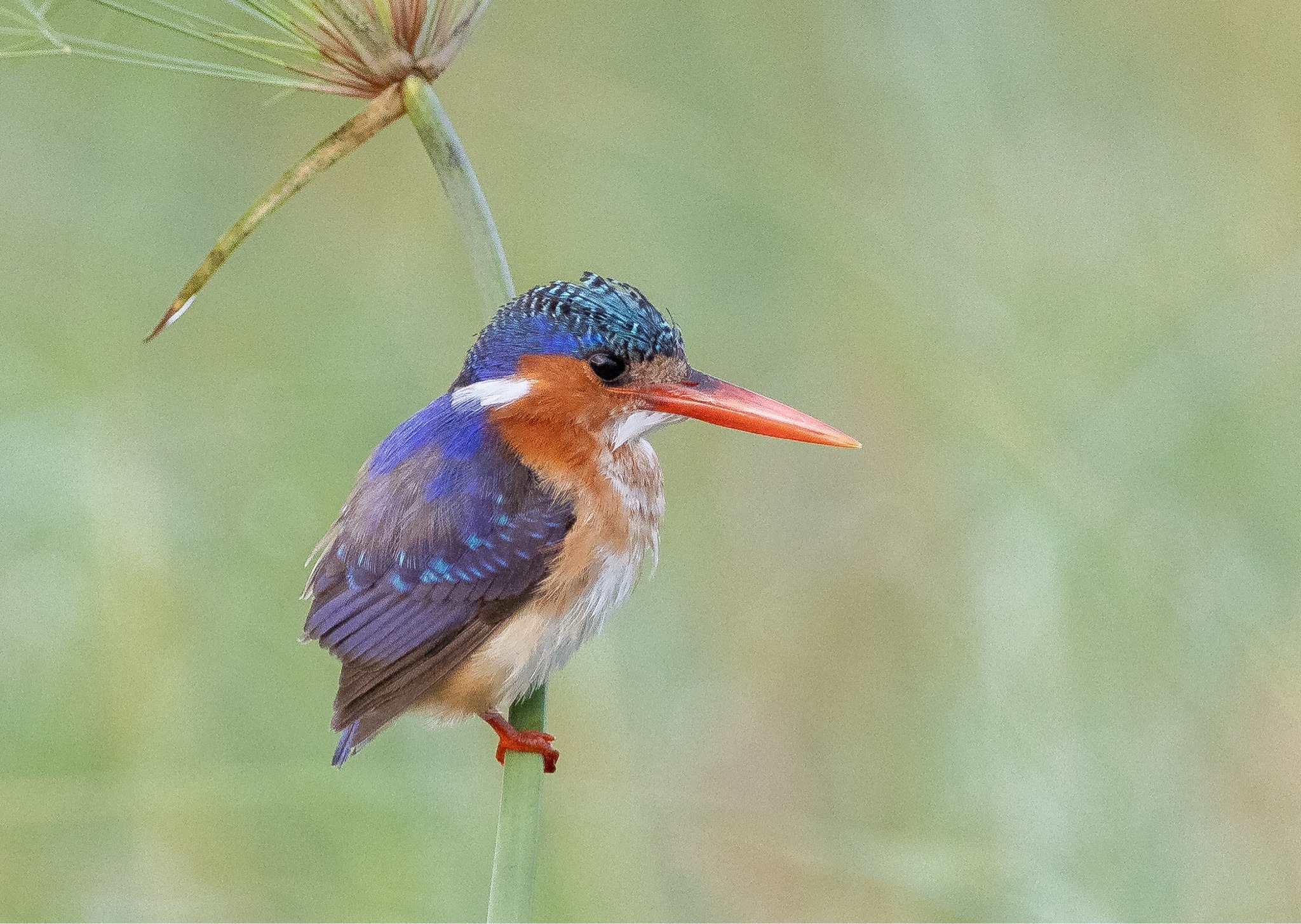
A very small, intensely colored kingfisher with a short tail and a long, pointed bill. It is usually seen perched low over water on reeds or branches, diving suddenly to catch prey.
Explore Malachite Kingfisher in the encyclopedia →Identify your own birds.
Get a report just like this from any photo or call, free.
Plumage & appearance
Adults have brilliant metallic blue upperparts and a shaggy crest of blue and black feathers. The underparts are warm rufous-orange, with white patches on the throat and neck sides. The bill is bright red in adults and black in juveniles. Sexes are similar.
Key field marks
Brilliant blue upperparts, bright red bill (in adults), shaggy blue/black crest, and rufous-orange underparts with white throat.
Size & weight
Length: 13 cm (5.1 in); Wingspan: approx 22-25 cm; Weight: 12-19 g.
Voice — call & song
A high-pitched, sharp 'peep-peep' or 'seek-seek' often given in flight.
Diet & foraging
Primarily small fish, aquatic insects, crustaceans, and occasionally small frogs or tadpoles caught by diving into the water.
Habitat
Marshes, reed beds, lakes, slow-moving rivers, and coastal lagoons with plenty of emergent vegetation.
Migration & movement
Mainly resident, though it may perform local movements in response to changing water levels or food availability.
Nesting & breeding
Excavates a tunnel (up to 1 meter long) in a sandy or muddy riverbank ending in a nesting chamber. Lays 3-6 white eggs; both parents incubate and feed the young.
Similar species
The Malachite Kingfisher is similar to the Half-collared Kingfisher (which is larger with a black bill) and the African Pygmy Kingfisher (which has more orange on the face and prefers drier woodland habitats).
Ecological significance
Acts as an indicator of wetland health and controls populations of small fish and aquatic insects.
Conservation status
Least Concern (IUCN); Population is stable.
Observation tips
Look for them perched low on reeds or papyrus bordering slow-moving rivers, lagoons, and swamps. They are often approachable but fly fast and low over the water when disturbed.
Interesting facts
Despite its small size, it is a formidable hunter capable of catching fish nearly half its body length. It often beats its prey against a branch before swallowing it to soften the bones and scales.
More like this