Order: Anseriformes, Family: Anatidae
Green-winged Teal
Anas carolinensis
The Green-winged Teal is the smallest dabbling duck in North America, characterized by its compact body, short neck, and rapid, agile flight.
Explore Green-winged Teal in the encyclopedia →Identify your own birds.
Get a report just like this from any photo or call, free.
Plumage & appearance
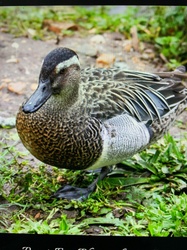
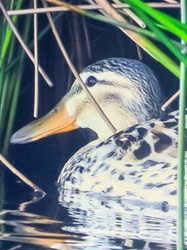
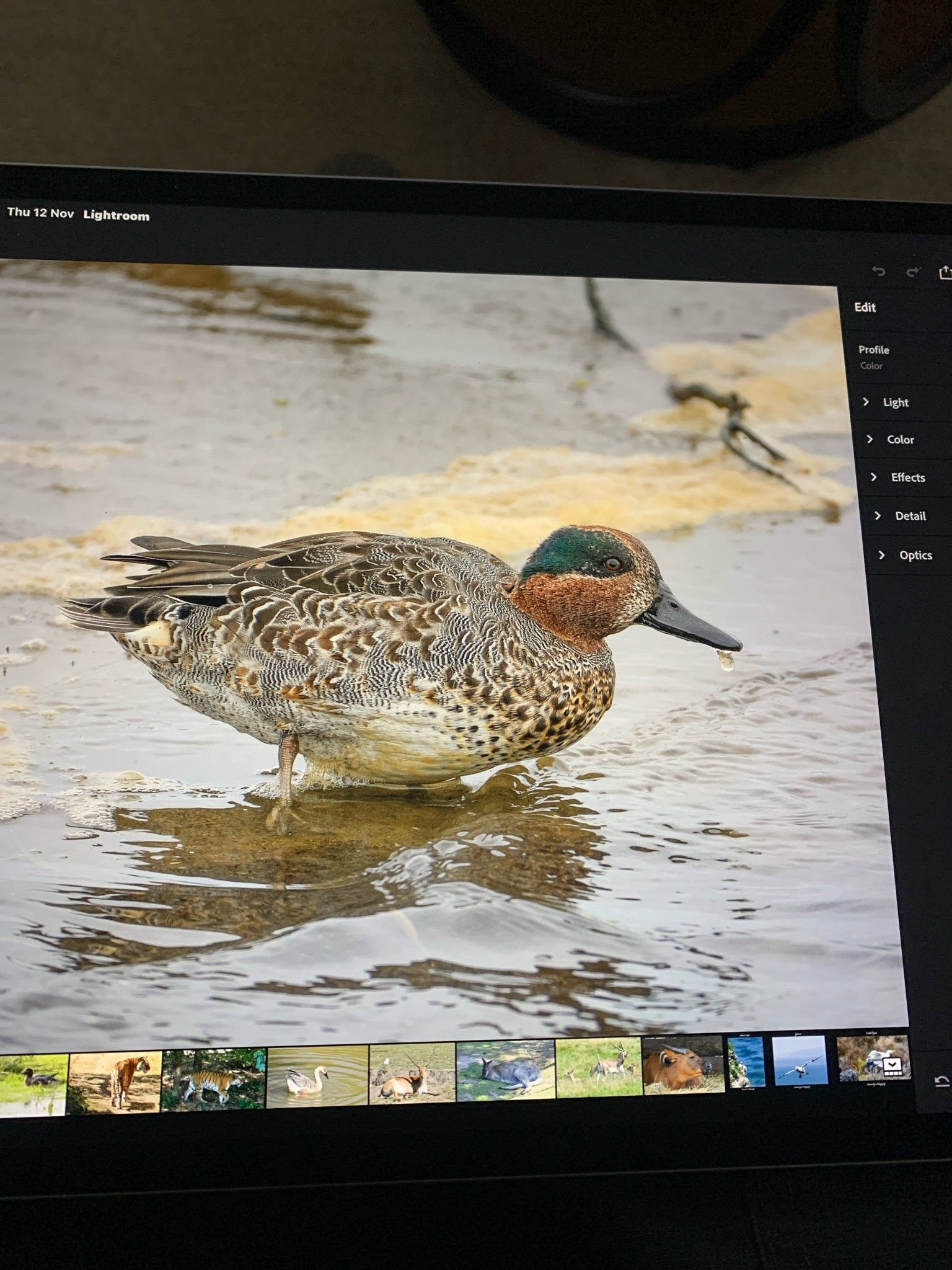
Adult males feature a striking chestnut head with a wide, iridescent green eyepatches extending to the back of the neck, a finely vermiculated grey body, a vertical white mark on the breast, and a yellowish-buff patch on the rear flanks. Females and non-breeding males are mottled brown with a whitish belly and a dark-streaked face.
Key field marks
Smallest dabbling duck, iridescent green head patch on males, horizontal white scapular line along the back, and buffy patch under the tail.
Size & weight
Length: 31-39 cm (12-15 inches), Wingspan: 58-64 cm (23-25 inches), Weight: 140-500 g (5-18 oz)
Voice — call & song
Males give a clear, musical, rising whistle (kree-eek), while females emit a soft, low quack.
Diet & foraging
Primarily feeds on seeds of aquatic grasses, sedges, and weeds, as well as aquatic insects, crustaceans, and mollusks by dabbling or tipping up in shallow water.
Habitat
Shallow freshwater marshes, ponds, estuaries, sheltered coastal bays, and flooded fields.
Migration & movement
Strongly migratory, traveling in flocks from northern breeding grounds to southern wintering areas.
Nesting & breeding
Nests on the ground in well-concealed spots among tall grass or shrubs near water. Lays 6 to 11 creamy-white or buff eggs. Incubation is done entirely by the female for about 21 to 23 days.
Similar species
Eurasian Teal (Anas crecca), which males differ from primarily by lacking the vertical white breast stripe, though the two are often considered conspecific.
Ecological significance
Acts as an important seed disperser for aquatic plants and helps control invertebrate populations in wetland ecosystems.
Conservation status
Least Concern, with stable populations globally.
Observation tips
Look for them in shallow wetlands, marshes, and flooded agricultural fields, often feeding alongside other dabbling ducks. They are skittish and flush quickly when approached.
Interesting facts
Despite their small size, Green-winged Teals are exceptionally strong flyers capable of taking off vertically straight out of the water.
More like this