Order: Passeriformes, Family: Ptilogonatidae
Phainopepla
Phainopepla nitens
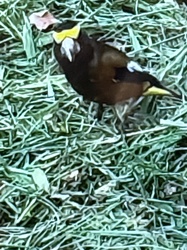
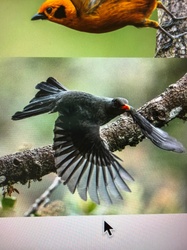
A slender, crested songbird with red eyes, a long tail, and a sleek silky appearance, often behaving like a flycatcher by making aerial sallies after insects.
Explore Phainopepla in the encyclopedia →Identify your own birds.
Get a report just like this from any photo or call, free.
Plumage & appearance
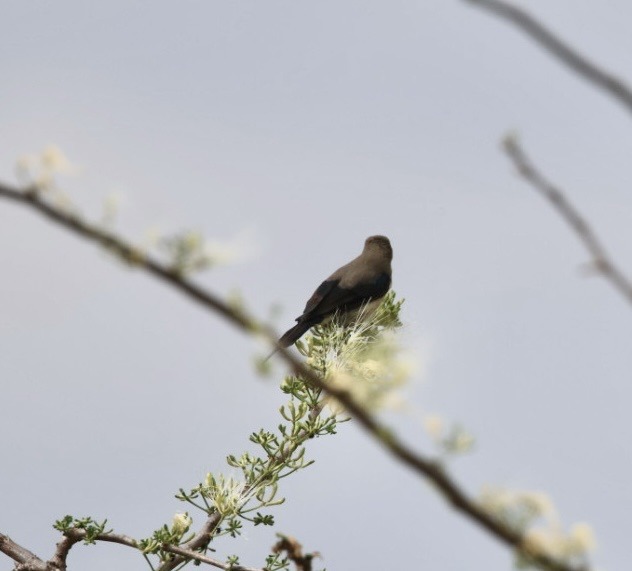
Males are glossy, silky bluish-black with white wing patches visible in flight and a prominent crest; females are brownish-gray with grayer wing patches and a less pronounced crest.
Key field marks
Prominent crest, slender body, long tail, silky black plumage (male) or brownish-gray (female), and white wing patches.
Size & weight
Length: 18-20 cm (7-8 inches), Wingspan: approx. 28 cm (11 inches), Weight: 22-30 g (0.8-1.1 oz)
Voice — call & song
A soft, conversational 'wurp' call and a weak, warbling song.
Diet & foraging
Primarily mistletoe berries and flying insects caught on the wing.
Habitat
Desert scrub, arid woodlands, mesquite thickets, pinyon-juniper, and riparian zones heavily laden with mistletoe.
Migration & movement
Nomadic and migratory; breeds twice in different habitats, moving from low deserts to higher oak woodlands in spring.
Nesting & breeding
Builds a shallow, cup-like nest in trees or shrubs; clutch size is typically 2-3 eggs; both parents participate in incubation and rearing.
Similar species
Silky-flycatchers are unique in North America; female could potentially be confused with female blackbirds, but the slender shape, crest, and silky plumage distinguish it.
Ecological significance
Key disperser of mistletoe seeds in desert ecosystems, consuming the berries and excreting seeds onto branches.
Conservation status
Least Concern, with stable or slightly increasing populations.
Observation tips
Look for them perched upright on high branches in desert washes or mistletoe-heavy mesquite trees; listen for their soft, cat-like calls.
Interesting facts
Uniquely, the Phainopepla has two distinct breeding seasons and utilizes two completely different habitats in a single year, moving between desert and woodland environments.
More like this