Order: Suliformes, Family: Phalacrocoracidae
Double-crested Cormorant
Nannopterum auritum
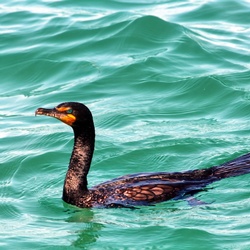
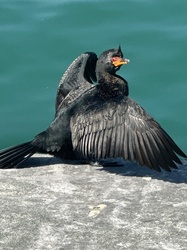
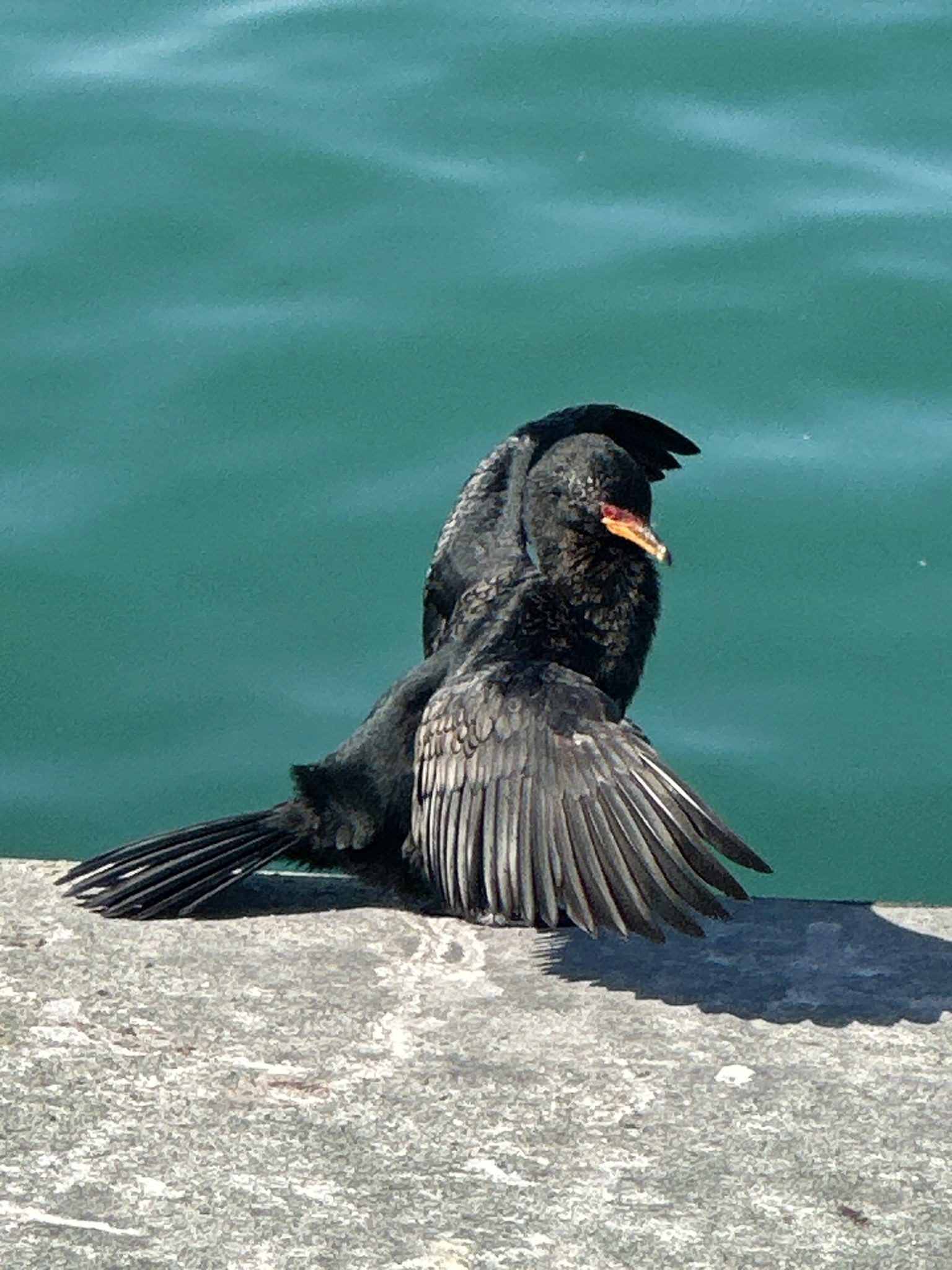
A large, water-loving bird with a dark body, long neck, hooked bill, and characteristic habit of standing with wings spread out to dry after diving.
Explore Double-crested Cormorant in the encyclopedia →Identify your own birds.
Get a report just like this from any photo or call, free.
Plumage & appearance
Adults are mostly black with a coppery sheen on the back and wings. They feature a bare orange-yellow throat pouch (gular skin) and small double crests of black and white feathers behind the eyes during the breeding season. Juveniles are brownish-gray with paler underparts and a yellowish-orange throat.
Key field marks
Large black body, hooked bill, orange-yellow throat pouch, and the classic post-dive wing-drying posture.
Size & weight
Length: 70–90 cm (28–35 in), Wingspan: 114–123 cm (45–48 in), Weight: 1.2–2.5 kg (2.6–5.5 lbs).
Voice — call & song
Generally silent away from breeding colonies, but makes guttural, low-pitched croaking, grunting, and growling sounds at nesting sites.
Diet & foraging
Primarily fish, supplemented by amphibians, crustaceans, and aquatic insects. Forages by diving from the surface and pursuing prey underwater using its webbed feet.
Habitat
Found in both marine and freshwater environments, including coastal bays, estuaries, large lakes, rivers, and reservoirs.
Migration & movement
Partial migrant. Northern populations migrate south for the winter, while coastal and southern populations are largely year-round residents.
Nesting & breeding
Builds bulky stick nests on cliffs, trees, or on the ground on isolated islands. Lays a clutch of 3 to 4 pale blue-green eggs. Both parents share incubation and feeding duties.
Similar species
Neotropic Cormorant (smaller with a differently shaped throat pouch) and Anhinga (sharper, dagger-like bill and longer, fan-like tail, though anhingas also dry wings).
Ecological significance
Acts as an apex predator in aquatic food webs, helping to control fish populations and serving as an indicator of aquatic ecosystem health.
Conservation status
Least Concern, with stable or increasing populations across most of its range.
Observation tips
Look for them perched on docks, pilings, rock outcrops, or tree branches near water with their wings fully outstretched to dry.
Interesting facts
Unlike most other waterbirds, cormorants do not have fully waterproof feathers, which allows them to dive deeper without buoyancy interference but requires them to dry their wings in the sun afterwards.
More like this