Order: Galliformes, Family: Phasianidae
Wild Turkey
Meleagris gallopavo
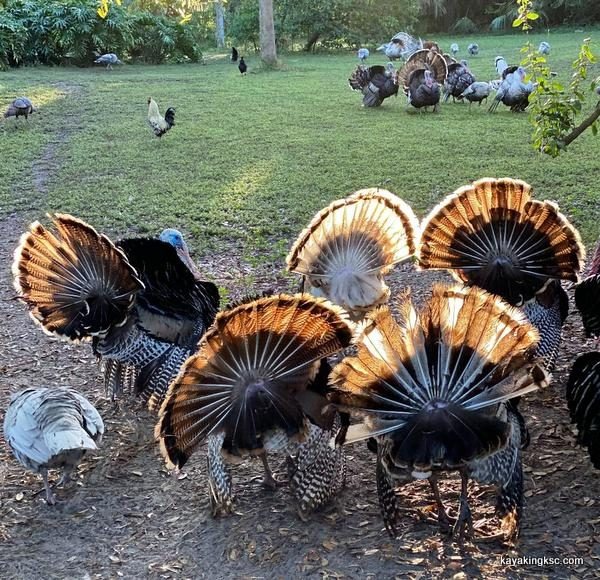
Large, heavy-bodied ground-dwelling birds with fans of tail feathers, long legs, and bald heads. Males perform elaborate courtship displays by fanning their tails and dropping their wings.
Explore Wild Turkey in the encyclopedia →Identify your own birds.
Get a report just like this from any photo or call, free.
Plumage & appearance
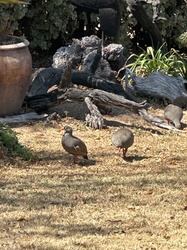
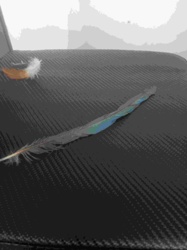
Adult males (toms) feature iridescent bronze, copper, green, and gold plumage, a bare blue and red head, a fleshy appendage (snood) above the bill, and a wattle on the throat. Adult females (hens) are smaller and have duller, brownish-gray feathers to blend in with nesting environments.
Key field marks
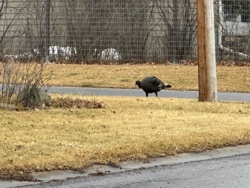
Large dark silhouette, fan-shaped tail with a distinct lighter or dark terminal band depending on subspecies, long bare bluish head, and prominent beard-like bristle protruding from the male's chest.
Size & weight
Length: 39-48 inches (100-122 cm); Wingspan: 49-57 inches (125-144 cm); Weight: 5-24 pounds (2.2-11 kg), with males being significantly larger than females.
Voice — call & song
Famous for the loud 'gobble' call produced by males, alongside various clucks, yelps, putts, and purrs used for flock communication.
Diet & foraging
Omnivorous; feeds on nuts (acorns), seeds, fruits, insects, small amphibians, and vegetation, foraging primarily by scratching at the ground.
Habitat
Mature deciduous and mixed conifer-hardwood forests with scattered openings, clearings, and agricultural fields close to water sources.
Migration & movement
Permanent resident. They do not migrate long distances, though they may shift elevation seasonally in mountainous regions.
Nesting & breeding
Ground nesters; females scratch a shallow depression in the ground hidden under brush, shrubs, or logs. Clutch size ranges from 9 to 13 eggs, incubated solely by the hen for about 28 days.
Similar species
Domestic turkeys are descended from the same species and can look similar, but wild turkeys are generally slimmer, faster runners, and have darker, more patterned tips on their tail feathers.
Ecological significance
Wild turkeys act as important seed dispersers and invertebrate predators, helping regulate insect populations and contributing to forest floor ecology.
Conservation status
Least Concern, with stable and widespread populations due to successful conservation and reintroduction programs.
Observation tips
Look along forest edges, agricultural fields, and open woodlands in the early morning or late afternoon. Approaching quietly or using turkey calls can help locate them.
Interesting facts
Wild turkeys can run up to 25 mph and fly in short bursts at speeds up to 55 mph. They spend their nights roosting high up in trees to avoid predators.
More like this