Order: Passeriformes, Family: Parulidae
Pine Warbler
Setophaga pinus
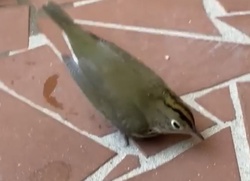
A chunky, medium-sized wood-warbler strongly associated with pine forests. It has a slightly larger, heavier bill than many other warblers and often creeps along tree branches rather than darting about.
Explore Pine Warbler in the encyclopedia →Identify your own birds.
Get a report just like this from any photo or call, free.
Plumage & appearance
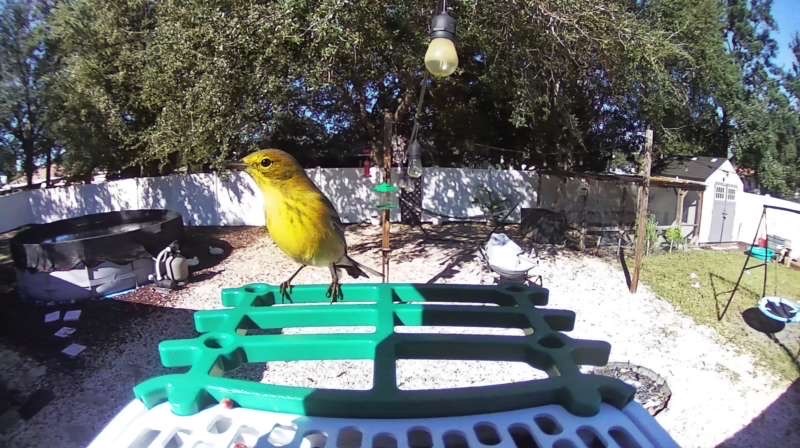
Adult males typically feature a bright yellow throat and breast, duller olive-green upperparts, and two distinct white wingbars. Females and immatures are browner and duller, with a yellowish wash on the throat.
Key field marks
Bright yellow throat and breast, two white wingbars, dark eye set against a relatively plain face, and a preference for foraging on pine tree trunks and branches.
Size & weight
Length: 13-14 cm (5.1-5.5 in), Wingspan: 21-23 cm (8.3-9.1 in), Weight: 9-14 g (0.3-0.5 oz)
Voice — call & song
Song is a bright, clear, musical trill on a single pitch, similar to the song of a Chipping Sparrow or Dark-eyed Junco.
Diet & foraging
Primarily insects and spiders during the breeding season, but shifts to include seeds, berries, and suet during the winter months.
Habitat
Open pine woods, particularly stands of longleaf, loblolly, or pitch pine. Frequently found in suburban areas with mature pine trees.
Migration & movement
Partial migrant. Northern populations migrate to the southeastern United States and parts of the Caribbean for the winter, while southern populations are year-round residents.
Nesting & breeding
Builds an open cup nest made of twigs, bark strips, and pine needles placed high up in a pine tree, usually well out on a horizontal branch.
Similar species
Can be confused with the Yellow-throated Warbler or the Bay-breasted Warbler. Distinguished by its lack of a bold facial pattern, plain olive-green back, and strong association with pine trees.
Ecological significance
Acts as an important controller of insect populations, particularly caterpillars and beetles, in pine forest ecosystems.
Conservation status
Least Concern, with a stable population trend.
Observation tips
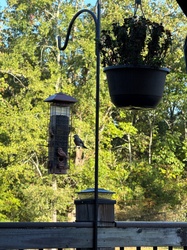
Look and listen high up in pine trees; unlike many warblers, they readily visit backyard bird feeders offering suet, sunflower seeds, and mealworms.
Interesting facts
The Pine Warbler is the only warbler species that spends the entire year in Canada and the northeastern United States that relies heavily on pine seeds in the winter.
More like this