Order: Cuculiformes, Family: Cuculidae
Burchell's Coucal
Centropus burchellii
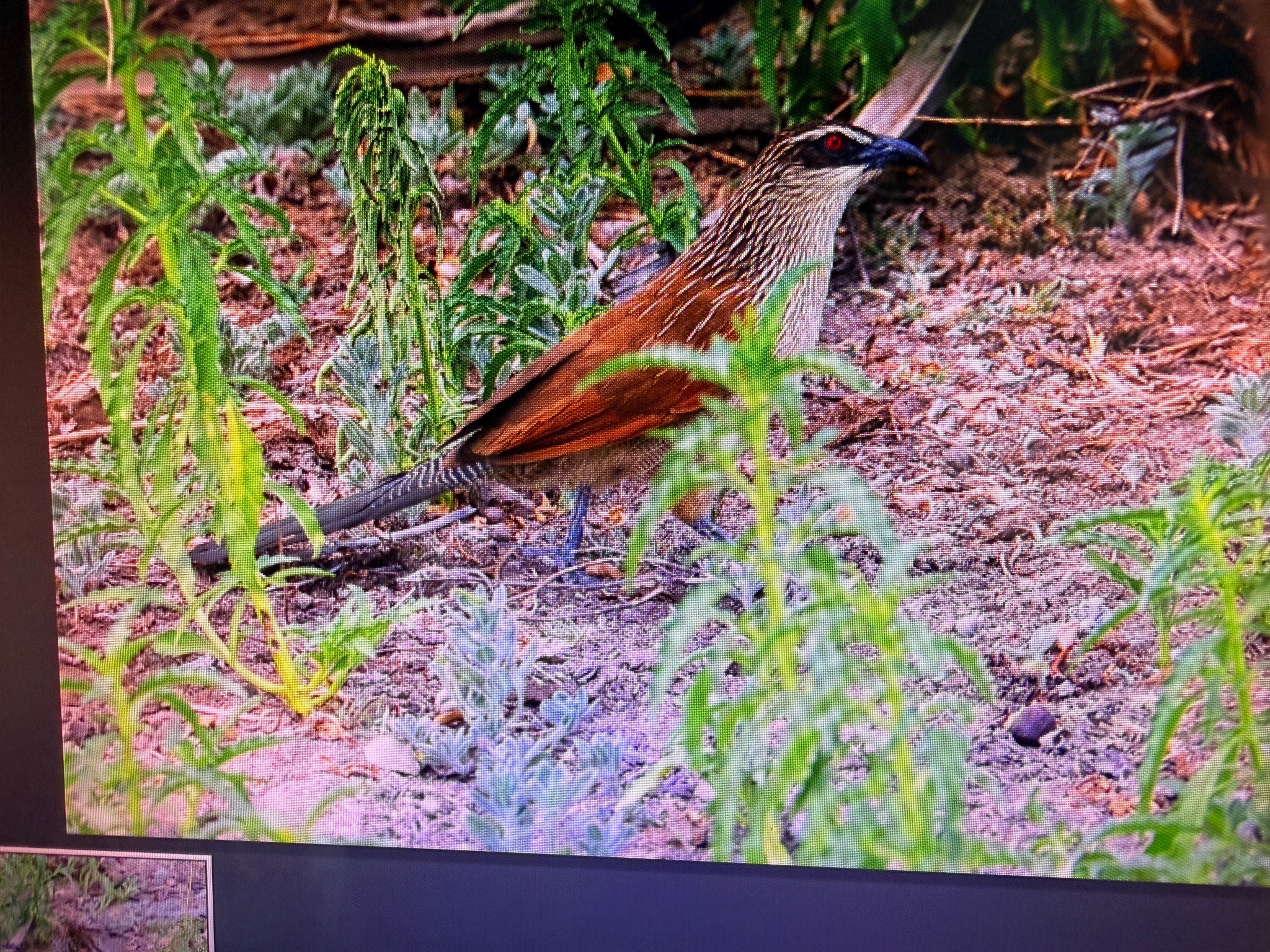
A large, terrestrial cuckoo with a heavy curved bill, bright red eyes, chestnut wings, and a long tail. It prefers walking on the ground or clambering through dense vegetation rather than flying.
Explore Burchell's Coucal in the encyclopedia →Identify your own birds.
Get a report just like this from any photo or call, free.
Plumage & appearance
Creamy-white to buff head and neck with heavy black streaking, rich chestnut-brown wings and back, and a long, dark greenish-black tail. Eyes are a distinctive bright red. Sexes are similar in plumage, though females are often slightly larger.
Key field marks
Bright red eye, heavy black-streaked head and neck contrasting with rich chestnut wings, and a long dark tail.
Size & weight
Length: 35-42 cm, Wingspan: approx. 45-50 cm, Weight: 150-300 g.
Voice — call & song
Famous for its distinctive, bubbling, water-pouring-out-of-a-bottle call, which often starts low and rises in pitch.
Diet & foraging
Carnivorous and omnivorous, feeding on large insects, spiders, snails, frogs, lizards, small rodents, and occasionally bird eggs and nestlings.
Habitat
Thick vegetation, reedbeds, marshes, riverine bush, scrub, and overgrown gardens, usually near water.
Migration & movement
Non-migratory resident, highly sedentary.
Nesting & breeding
Builds a bulky, domed nest of leaves and grass hidden in dense reeds or low bushes. Lays 2 to 4 white eggs. Unlike brood-parasitic cuckoos, Burchell's Coucals raise their own young with shared parental care.
Similar species
Senegal Coucal, which is very similar in appearance but generally found further north with some overlap in East Africa; distinguished by subtle differences in back and wing coloration and range.
Ecological significance
Acts as an important predator of large insects, small vertebrates, and reptiles, helping to control local pest populations within its wetland and bushveld habitats.
Conservation status
Least Concern, with a stable population trend.
Observation tips
Look for them skulking in dense reedbeds, thickets, or rank grass near water. They are often spotted sunning themselves in the morning with their wings drooped.
Interesting facts
Despite belonging to the cuckoo family, Burchell's Coucals do not practice brood parasitism and build their own nests, raising their own offspring.
More like this