Order: Passeriformes, Family: Thraupidae
Hooded Mountain Tanager
Bangsia edwardsi
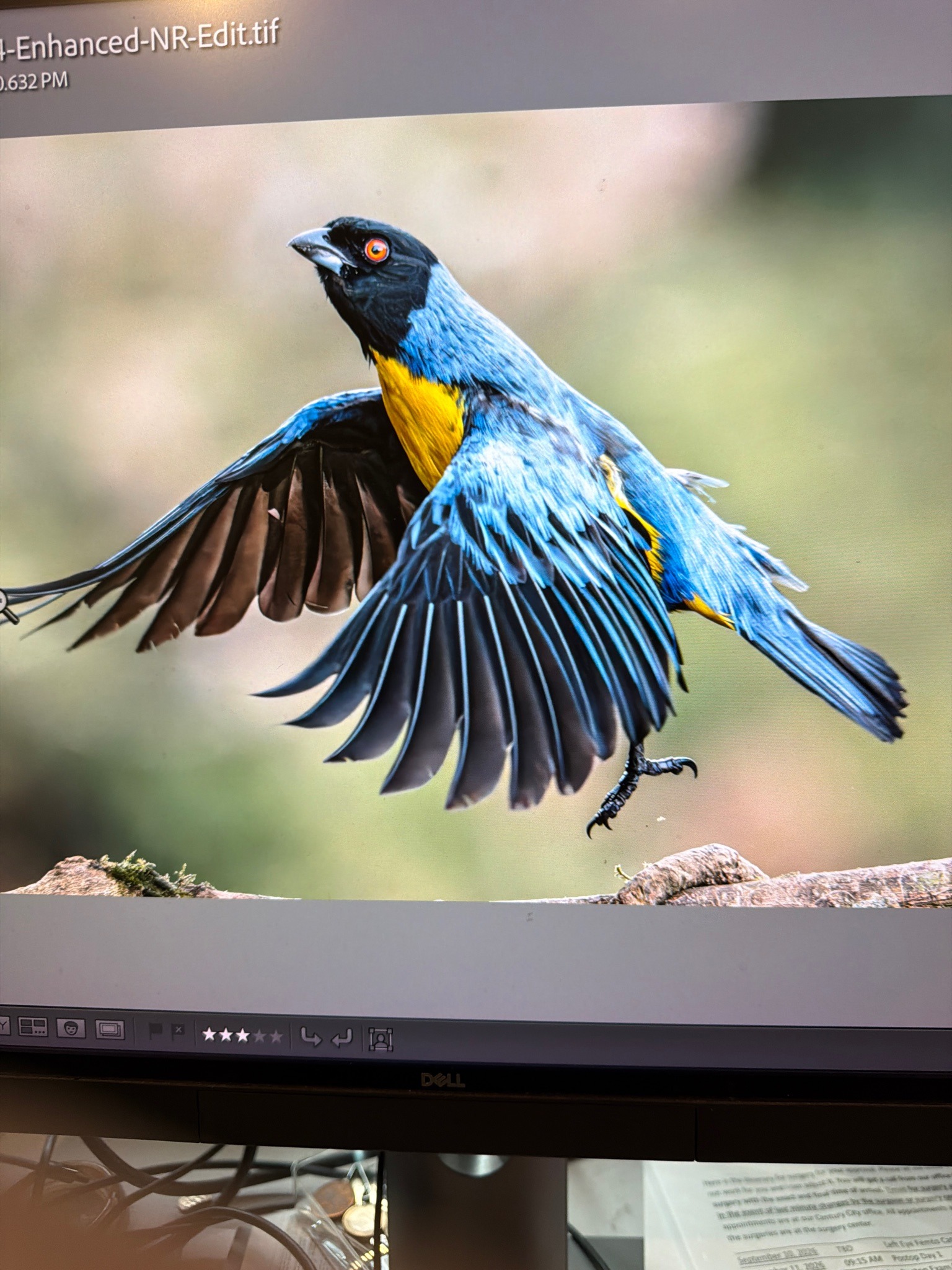
A striking, medium-sized tanager with a velvety black hood, brilliant yellow chest patch, and vibrant blue upperparts, known for moving actively in mixed-species flocks through cloud forests.
Explore Hooded Mountain Tanager in the encyclopedia →Identify your own birds.
Get a report just like this from any photo or call, free.
Plumage & appearance
Adults have a striking black head, throat, and upper breast with a contrasting bright yellow breast patch and belly center. The upperparts and wing coverts are deep cobalt blue to turquoise. Flight feathers are blackish edged with blue. Juveniles are duller with less distinct contrasts.
Key field marks
Velvety black head and throat contrasting with a bright yellow breast patch, flanked by brilliant blue upperparts and dark flight feathers.
Size & weight
Length: approximately 16-18 cm; Weight: around 35-45 g
Voice — call & song
High-pitched chips, thin squeaks, and quiet chattering calls typical of tanagers in a flock.
Diet & foraging
Frugivorous and insectivorous; feeds on small berries, fruits, and gleans insects from foliage and mossy branches.
Habitat
Humid montane forests, cloud forests, and dense secondary growth, typically at elevations between 900 and 2,200 meters.
Migration & movement
Resident (non-migratory), though local altitudinal movements may occur.
Nesting & breeding
Builds a bulky cup nest of moss, rootlets, and plant fibers hidden in dense vegetation or epiphytes on trees.
Similar species
Other members of the genus Bangsia, such as the Golden-chested Tanager, but distinguished by the extensive black hood and bright yellow central underparts.
Ecological significance
Acts as an important seed disperser and insect predator within its montane forest ecosystem.
Conservation status
Least Concern, with populations stable though locally threatened by deforestation.
Observation tips
Look for them in the mid-to-upper strata of humid montane forests and forest edges, often by listening for their vocalizations in mixed-species flocks.
Interesting facts
Tanagers represent one of the largest families of birds, with the genus Bangsia named in honor of the American zoologist Outram Bangs.
More like this