Order: Passeriformes; Family: Hirundinidae
Barn Swallow
Hirundo rustica
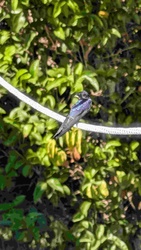
A small, agile songbird known for its deeply forked tail and acrobatic flight. Often seen perched on wires or fences near human structures.
Explore Barn Swallow in the encyclopedia →Identify your own birds.
Get a report just like this from any photo or call, free.
Plumage & appearance
Steely blue-black upperparts, rufous (tawny) forehead and throat, and a buffy-to-orange underside. Males are typically more brightly colored than females with longer tail streamers.
Key field marks
Deeply forked tail with long outer streamers, blue-black back, and orange/cinnamon throat.
Size & weight
Length: 5.9–7.5 in; Wingspan: 12.6–13.8 in; Weight: 0.6–0.7 oz
Voice — call & song
A musical twittering warble ending in a dry rattle or 'wit-wit' sounds.
Diet & foraging
Almost exclusively insects caught on the wing, such as flies, beetles, and dragonflies.
Habitat
Open areas near water and human structures, including meadows, farm fields, and suburban gardens.
Migration & movement
Long-distance migrant; breeds in Northern Hemisphere and winters in Central/South America, Africa, or SE Asia.
Nesting & breeding
Builds cup-shaped mud nests lined with grass and feathers on vertical surfaces like barn rafters or porch eaves.
Similar species
Cliff Swallow (square tail, pale rump) and Tree Swallow (green-blue back, pure white belly).
Ecological significance
Significant insectivore that helps control populations of flies, gnats, and beetles.
Conservation status
Least Concern (IUCN); population is large though some local declines are noted.
Observation tips
Look for them near farm buildings, under bridges, or over open fields. They are frequently seen resting on power lines or the decorative garden hooks prominent in suburban yards.
Interesting facts
The Barn Swallow is the most widespread species of swallow in the world and has a historic relationship with humans by using man-made structures for nesting.
More like this