Order: Passeriformes, Family: Estrildidae
Blue-capped Cordon-bleu
Uraeginthus cyanocephalus
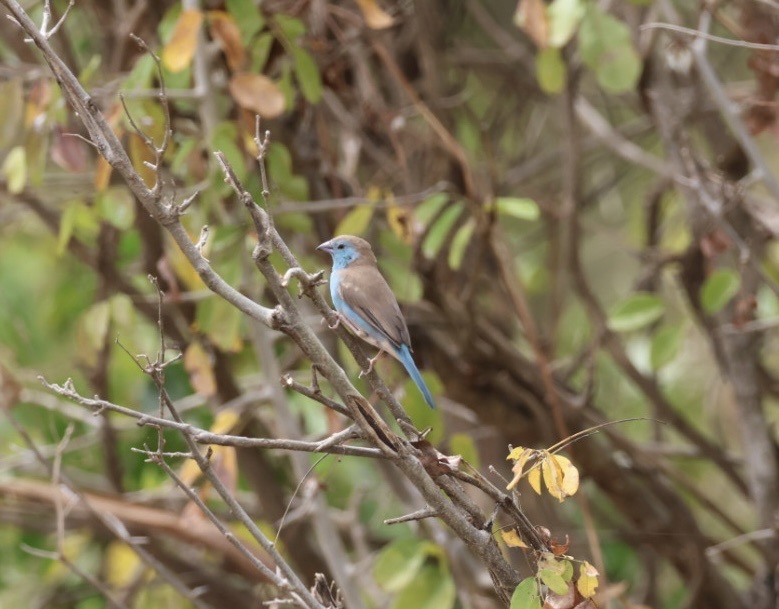
A small, active estrildid finch easily recognized by its striking powder-blue underparts and head, contrasting with brown upperparts. Highly social, often seen in pairs or small family groups.
Explore Blue-capped Cordon-bleu in the encyclopedia →Identify your own birds.
Get a report just like this from any photo or call, free.
Plumage & appearance
Adults feature bright blue heads, necks, breasts, and rumps, contrasting with a warm brown back, wings, and tail. Females are similar to males but generally have slightly less extensive or duller blue on the head and breast.
Key field marks
Bright blue head and underparts, brown upperparts, blue rump and tail, and a pinkish-red bill with a dark tip.
Size & weight
Length: 13-14 cm, Weight: 10-13 g, Wingspan: Approx. 15-18 cm
Voice — call & song
A soft, high-pitched tsit-tsit call and a pleasant, warbling song delivered from a prominent perch.
Diet & foraging
Primarily granivorous, feeding on small grass seeds, complemented by small insects especially during the breeding season.
Habitat
Dry savannah, arid scrub, acacia woodlands, thornbush, and cultivated lands.
Migration & movement
Resident (non-migratory)
Nesting & breeding
Builds a spherical grass nest with a side entrance, often placed low in a thorny bush or tree. Clutch size is typically 4-5 white eggs. Both parents share incubation and feeding duties.
Similar species
Red-cheeked Cordon-bleu (Uraeginthus bengalus), which can be distinguished by the prominent red patch on the cheek that the Blue-capped Cordon-bleu lacks.
Ecological significance
Acts as a seed disperser for various grasses and is a frequent host for brood parasitism by village indigobirds.
Conservation status
Least Concern, with a stable population trend.
Observation tips
Look for them foraging on the ground for grass seeds or perching in low, thorny bushes in arid and semi-arid regions of East Africa.
Interesting facts
Like many estrildid finches, they engage in elaborate courtship dances involving rhythmic bobbing and holding a piece of grass in their bill while singing.
More like this