
Zone-tailed Hawk Identification Guide
A slim, dark hawk that mimics the flight style and silhouette of a Turkey Vulture, revealed by its banded tail and feathered head when seen well.
Read the full Zone-tailed Hawk encyclopedia entry →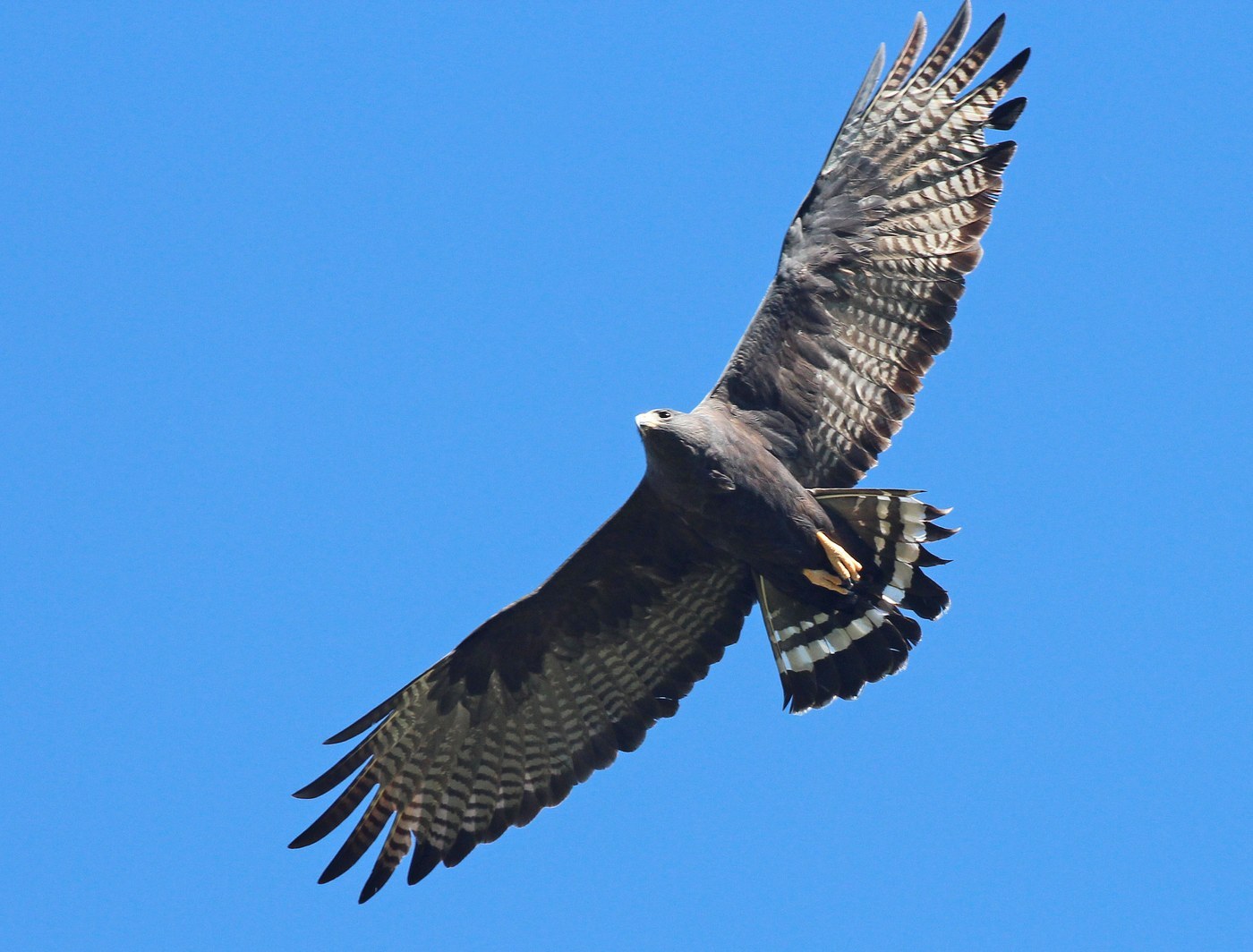
Key Field Marks
- Size & shape: A medium-large raptor with long, fairly narrow wings and a long tail, giving it a slimmer, more buteo-like silhouette than a true vulture despite its vulture-mimicking flight.
- Plumage: Overall sooty black to blackish-gray body and wing coverts, with flight feathers showing fine pale barring visible in good light or backlighting — similar overall tone to a Turkey Vulture at a distance.
- Tail: The key mark — a black tail crossed by one to three broad whitish-gray bands, most visible when the tail is fanned or backlit; this banded pattern is absent on Turkey Vultures.
- Head & bill: Unlike the bare red head of an adult Turkey Vulture, the Zone-tailed Hawk has a fully feathered gray-black head and a yellow cere (base of bill) with a hooked black-tipped bill typical of hawks.
- Flight: Flies with wings held in a shallow V (dihedral) and rocks and teeters from side to side, closely mimicking Turkey Vulture flight style — an adaptation thought to help it approach prey undetected while soaring alongside vulture flocks.
Separating It From Similar Species
- Turkey Vulture: Bare red (adult) or gray (juvenile) unfeathered head, plain unbanded tail, and a two-toned pale/dark underwing in even lighting; Zone-tailed Hawk has a feathered head and a banded tail, plus a slightly bulkier build and yellow feet visible at close range or in good light.
- Common Black Hawk: Broader wings, a single broad white tail band (rather than two or three), and a more compact, stockier shape; found in different habitat (near streams/rivers) versus the open country and mountains favored by Zone-tailed Hawk.
- Dark-morph buteos (e.g., Red-tailed Hawk dark morph): Lack the vulture-mimicking dihedral flight and tail-banding pattern, and typically show broader, more rounded wings without the slim, vulture-like proportions.
- Best approach: Scan mixed vulture flocks carefully for one bird holding a shallow V and rocking like the rest, then check the tail for pale banding and the head for feathering — the giveaway details.
Where & When to See It
- Habitat: Arid and semi-arid canyon country, mountainous terrain with cliffs and cottonwood-lined riparian corridors, and wooded foothills, often soaring over open desert, grassland, or rocky terrain.
- Range: Breeds in the southwestern United States (Arizona, New Mexico, west Texas) south through Mexico and Central America into South America; northern populations are migratory, while southern populations are largely resident.
- Season: In the U.S., most reliably found March through October; birds are scarcer and more localized in winter in the far southern part of their U.S. range.
Voice & Song Cues
- Generally silent much of the time like most raptors, but gives a shrill, descending, whistled "kreeeer" or squealing call, especially near the nest or during territorial disputes.
- Vocalizations are not typically useful for initial identification since the bird is usually detected visually while soaring; the call is more relevant for confirming nesting activity or agitation.
Frequently asked questions
How can I tell a Zone-tailed Hawk from a Turkey Vulture?
Check the tail for one to three pale bands (Turkey Vultures have a plain tail) and the head, which is fully feathered gray-black on the hawk versus bare red or gray on the vulture; both share a similar teetering, shallow-V flight style.
Why does a Zone-tailed Hawk fly like a Turkey Vulture?
Its similar dark plumage and rocking, dihedral flight are thought to be a form of mimicry that lets it soar unnoticed among vulture flocks, potentially helping it surprise prey.
Where do Zone-tailed Hawks live?
They favor arid canyons, mountainous terrain, and riparian corridors in the southwestern U.S. through Mexico, Central America, and into South America.
Is the Zone-tailed Hawk migratory?
Northern populations in the U.S. Southwest are migratory, present mainly March through October, while southern populations further into Mexico and Central/South America are largely resident year-round.
What does a Zone-tailed Hawk sound like?
It gives a shrill, descending whistled call, but is usually identified visually while soaring rather than by voice.